 Accessories
 Baby & Kids
 Blankets & Afghans
 Clothing
Easy Baby Blanket Crochet Pattern Free: A Beginner-Friendly Half Double Crochet Blanket
This easy baby blanket crochet pattern free of shaping, seaming, and color changes uses one stitch, half double crochet, worked back and forth in straight rows. It makes a blanket of about 30 × 36 inches before the optional border, and every row ends with its stitch count so you can check your work as you go.
 Nicole Sinclair
Published · 15 min read
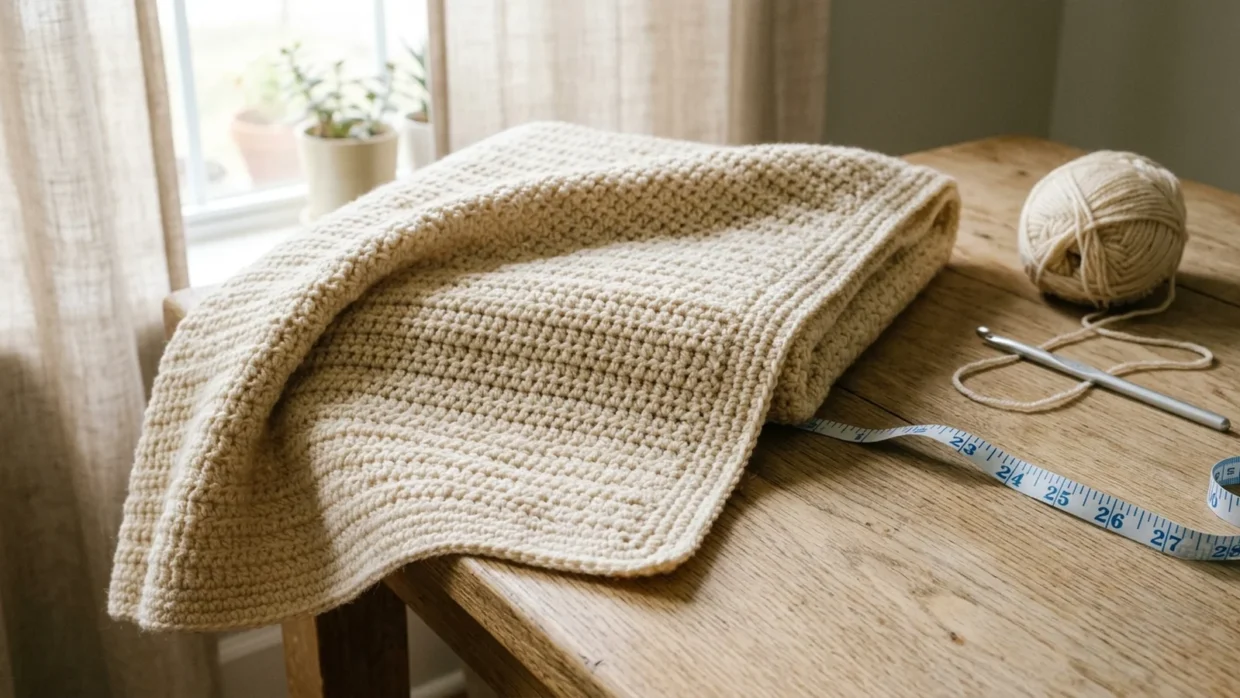
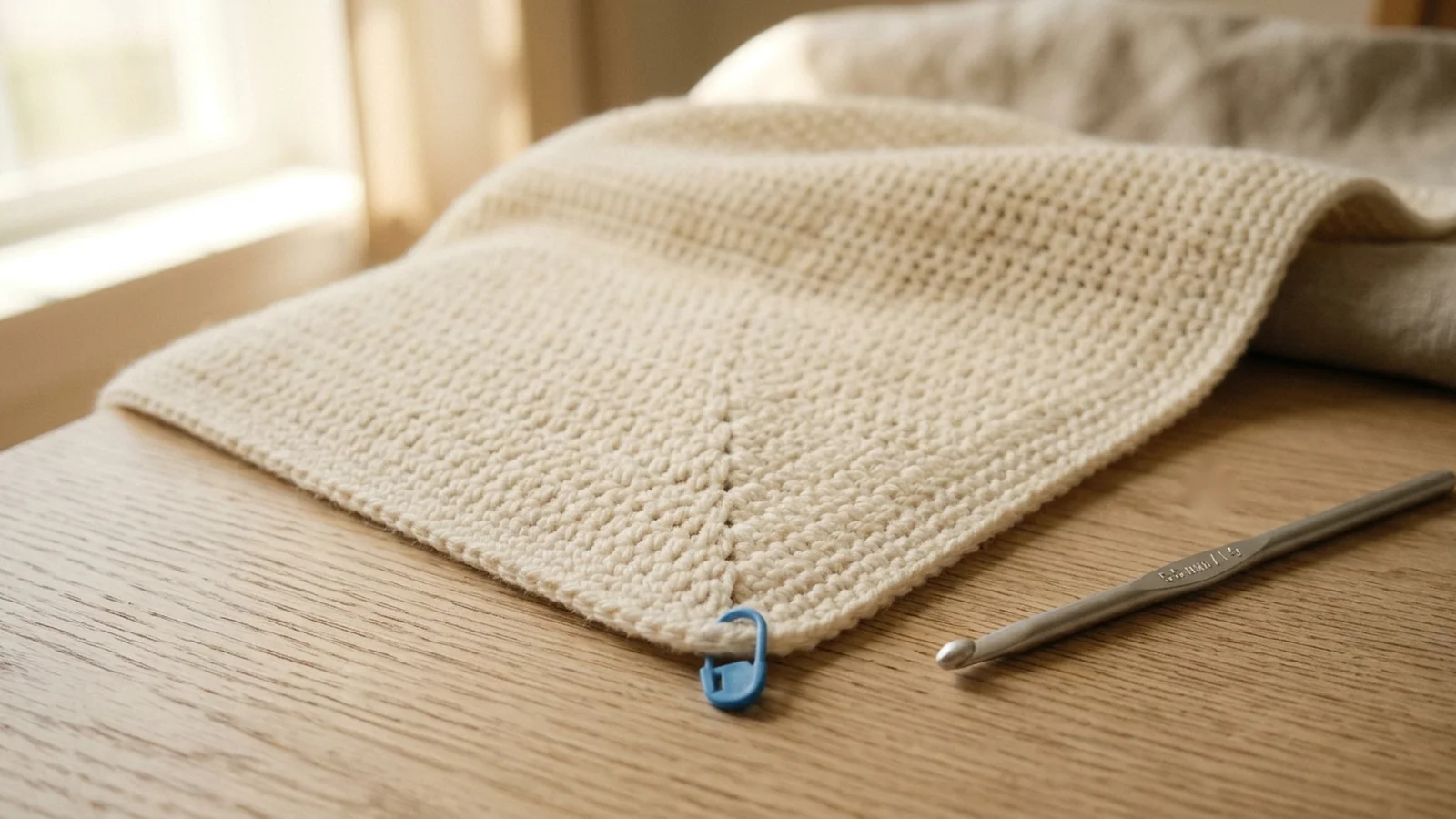
The finished blanket in solid cream worsted weight yarn, worked in half double crochet with a two-round single crochet border
Pattern at a Glance
- Skill level
- Beginner
- Yarn weight
- Worsted (#4)
- Hook size
- 5.5 mm (I-9)
- Finished size
- About 30 × 36 in before border
- Yarn needed
- Varies by yarn; see swatch method
- Construction
- One piece, worked flat in rows
- Stitches
- Chain, half double crochet, single crochet, slip stitch
- Gauge
- 14 sts × 10 rows = 4 in (target)
- Pattern type
- Free written pattern
- Project type
- Baby blanket
Is this the right easy baby blanket pattern for you?
Search for an easy baby blanket crochet pattern free of charge and you will find hundreds labeled beginner-friendly. The label usually means only that the stitches are basic. It does not tell you whether the blanket needs shaping, seaming, a fussy border, or a stitch count that quietly changes from row to row. This pattern keeps the construction plain and points out, ahead of time, the few places where a first blanket tends to go wrong.
Here is what the blanket actually asks of you:
- Chain stitch: one foundation chain of 107, counted once.
- Half double crochet: the only stitch in the body. There are 90 rows of 105 stitches each.
- Turning: at the end of every row, with a chain 2 that is not counted as a stitch.
- Single crochet and slip stitch: only for the optional border, including 3 single crochet into each corner.
- Weaving in ends with a tapestry needle.
What it leaves out matters as much. There are no increases or decreases, no seams, no pieces to join, no chain spaces to find, and no repeat to memorize. The stitch count is 105 in every row, so any row can be checked against the one below it.
That makes it easy to follow, but not effortless. Three things deserve attention. The foundation chain is long enough that miscounting is easy. Half double crochet has one more step than single crochet, because the final pull-through goes through three loops. And with 90 rows, a small habit at the edge gets repeated 90 times. I would call this a good first blanket for someone who can already chain and make a half double crochet. If you have never held a hook, work the practice swatch below a couple of times first.
If you want something smaller for a new arrival, browse crochet newborn blanket patterns first. You can also shrink this one with the resizing table further down.
Materials
- Yarn: worsted weight (#4), smooth and plied, in a light or medium solid color. This is a category, not a required brand. The quantity is worked out from your own swatch (method below), because a yardage figure would only be a guess for the yarn you choose.
- Hook: 5.5 mm (I-9) as a starting point. Change the size to match the gauge below rather than the other way around.
- Tapestry needle, scissors, and a tape measure.
- Stitch markers or scraps of contrasting yarn: 8 is comfortable, and 4 is the minimum for the border.
- Optional: a kitchen scale that reads in grams, for the yarn estimate.
For fiber, I would choose a machine-washable acrylic or acrylic blend for a first blanket. It is forgiving when your tension wanders, it stays light, and it is easy to launder. Cotton and cotton blends give sharper stitch definition and a cooler, heavier fabric, but they have less give, so uneven tension shows more. Wool and wool blends can be lovely, but many need gentler washing, which is worth thinking about for something that will be washed often. Whatever you choose, read the washing instructions on the ball band before you buy.
Skip fuzzy, eyelash, chenille, and other novelty yarns for this project, and skip very dark colors too. They hide the tops of the stitches, and in this pattern you need to see the top of the last stitch in every row. Yarn quantity is calculated from your swatch in the next section. For a broader look at how much yarn for a crochet blanket takes at different sizes and weights, see the guide on how much yarn for a crochet blanket.
Finished size and gauge
Target gauge: 14 stitches and 10 rows = 4 inches (10 cm) square, in half double crochet with a 5.5 mm hook.
The body is 105 stitches wide and 90 rows long. At the target gauge that works out to about 30 inches wide (105 ÷ 3.5) and 36 inches long (90 ÷ 2.5), before any border. Those figures are calculated from the target gauge rather than measured on a finished test blanket, so treat them as a target. Your own swatch is the real measurement.
Gauge is not critical for fit, because a blanket does not have to fit anyone. It does change three things: the finished dimensions, the drape, and the amount of yarn you use. Worked very tightly, half double crochet turns stiff. Worked very loosely, it gets holes that catch small fingers. The table shows how the same stitch and row counts change size.
| Your stitches per 4 in | Width of 105 stitches | Your rows per 4 in | Length of 90 rows |
|---|---|---|---|
| 13 | about 32.3 in | 9 | about 40 in |
| 14 (target) | 30 in | 10 (target) | 36 in |
| 15 | 28 in | 11 | about 32.7 in |
Stitch gauge and row gauge do not move together, so it is normal to be on target in one direction and off in the other. If your width is right but your rows run tall or short, measure the length as you work and stop when the blanket reaches the size you want, instead of counting to 90.
Make a gauge swatch first
I would swatch before starting, mainly to check how the fabric feels. A baby blanket should be soft and drapey, and tight half double crochet on a small hook is neither. The swatch is also your first practice at the row edges.
- Ch 22. (22 ch)
- Row 1: Hdc in the 3rd ch from hook and in each ch across. Turn. (20 sts)
- Rows 2–14: Ch 2, hdc in the first st and in each st across. Turn. (20 sts)
- Lay the swatch flat without stretching it. In the center, measure 4 inches across and count the stitches, then measure 4 inches up and count the rows. Compare with 14 stitches and 10 rows.
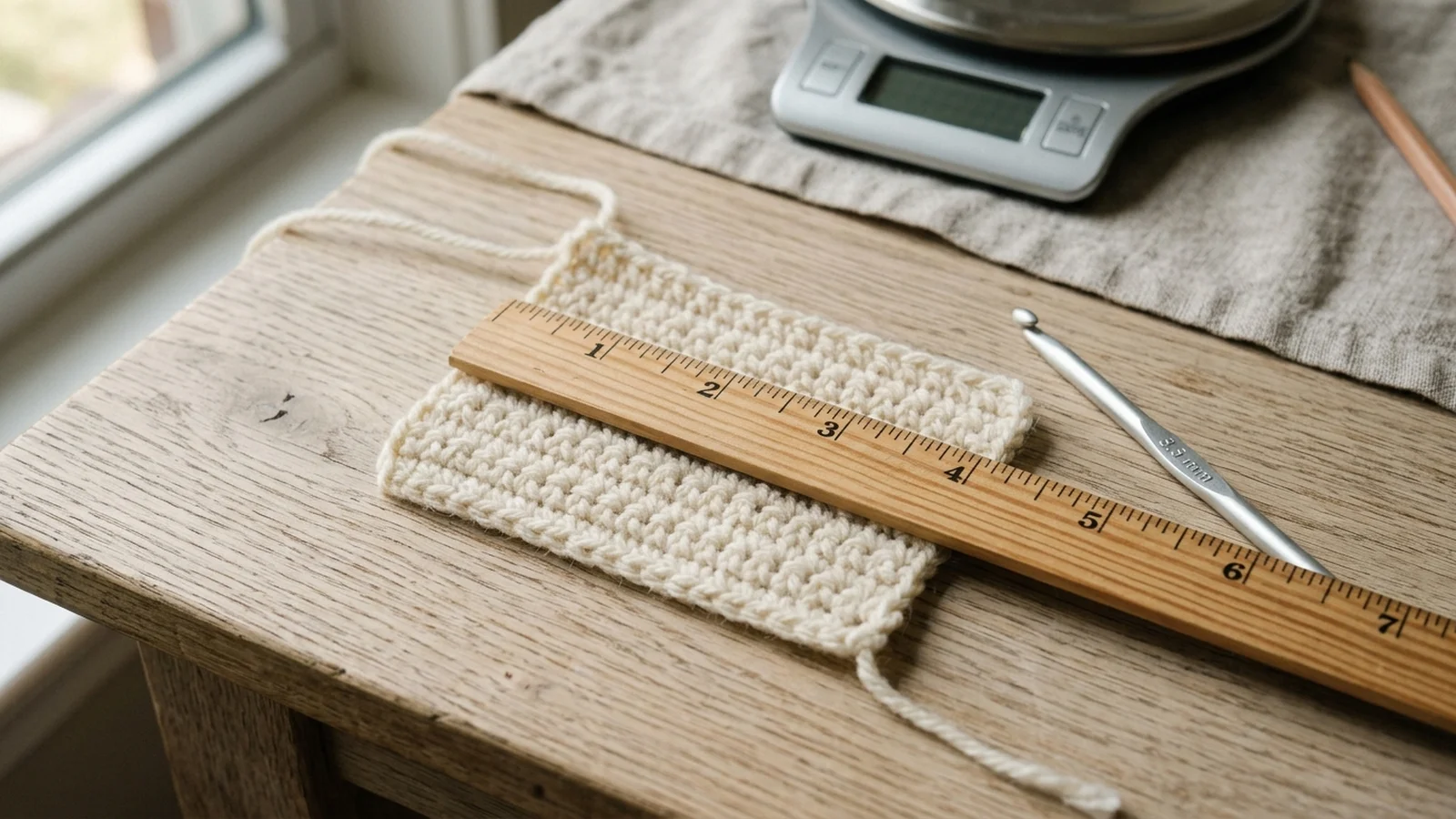
If you get more than 14 stitches in 4 inches, you are working tighter than the target, so try a 6.0 mm (J-10) hook. If you get fewer than 14, try a 5.0 mm (H-8). Swatch again after changing hooks, because a half-millimeter change can move the gauge by a full stitch.
Turn your swatch into a yarn estimate
The swatch has 20 × 14 = 280 stitches. The body of the blanket has 105 × 90 = 9,450, which is 33.75 times as many. That ratio gives you a yarn estimate without a made-up yardage figure:
- Trim the swatch tails to about 2 inches and weigh the swatch in grams.
- Multiply that weight by 34 to estimate the yarn for the body.
- Add at least 15% for the foundation chain, the border, the ends you will weave in, and a margin for error. This is my judgment call rather than a measured figure.
- Divide by the grams per ball on the label and round up to whole balls.
If your scale only reads whole grams, a larger swatch reduces rounding error. In that case, use blanket stitches ÷ swatch stitches as your multiplier instead of 34. Buy all the yarn at the same time and check that the balls share a dye lot, because a color shift partway through a solid blanket is very visible.
Abbreviations and stitches (US terms)
| Abbreviation | US term | UK equivalent |
|---|---|---|
| ch | chain | chain |
| st(s) | stitch(es) | stitch(es) |
| sl st | slip stitch | slip stitch |
| sc | single crochet | double crochet (dc) |
| hdc | half double crochet | half treble (htr) |
| yo | yarn over | yarn round hook (yrh) |
Everything in this pattern uses US terms. If you normally crochet from UK patterns, the one to watch is sc: it is a single crochet here, and it is called dc in UK patterns.
How to work a half double crochet
- Yarn over.
- Insert the hook into the stitch, under both strands at the top. The top of a hdc looks like a small sideways V.
- Yarn over and pull up a loop. You now have 3 loops on the hook.
- Yarn over and pull through all 3 loops.
Where the first and last stitch of each row go
This is the part that keeps the blanket straight. In this pattern the chain 2 at the start of a row is only a lift to bring the hook up to hdc height. It does not count as a stitch, and you never work into it later.
- First stitch: after you chain 2, work the first hdc into the very first stitch of the row below, the one directly under the chain. Do not skip it.
- Last stitch: work the last hdc into the top of the last hdc of the row below. The chain 2 from an earlier row will look like a small post at the very edge. The stitch you want is the first V just inside that post. Do not work into the post itself.
Easy baby blanket crochet pattern free: row-by-row instructions
The blanket is worked flat in rows with a 5.5 mm hook, or the hook size that gave you gauge. The chain 2 turning chain is never counted as a stitch, and the stitch count is 105 in every row.
Foundation chain
Ch 107. (107 ch) The slip knot and the loop on the hook do not count. The 2 extra chains are the turning chain you will skip in Row 1, which is why the chain is 2 longer than the 105 stitches.
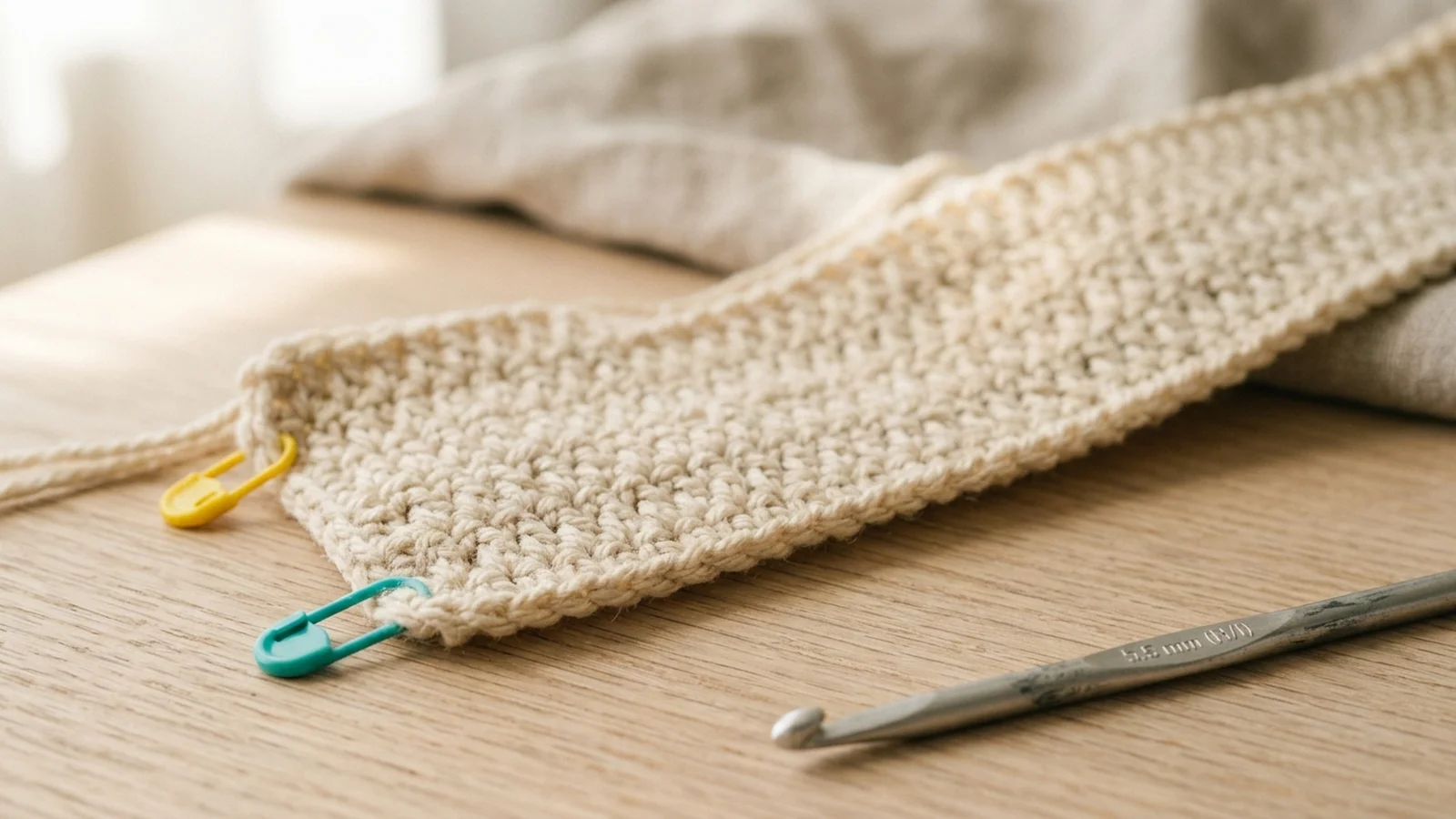
To make counting easier, clip a stitch marker into every 15th chain. The last marker will land on chain 105, with 2 chains left after it. Those 2 are the ones you skip. A foundation chain also tends to come out tighter than the rows above it. If yours does, use a hook 0.5–1 mm larger for the chain only, then switch back for Row 1.
Body
Row 1: Hdc in the 3rd ch from hook and in each remaining ch across, removing markers as you reach them. Turn. (105 sts)
Row 2: Ch 2 (does not count as a st), hdc in the first st and in each st across, working the last hdc in the top of the last hdc of the row below. Turn. (105 sts)
Rows 3–89: Repeat Row 2. (105 sts)
Row 90: Repeat Row 2. If you are adding the border, do not turn or fasten off. If you are skipping the border, fasten off and weave in your ends. (105 sts)
Two checks make the 90 rows manageable. Clip a marker to the edge every 10th row, so nine markers means you have reached Row 90. And after Row 10, lay the piece flat and measure. At target gauge it should be about 30 inches wide and about 4 inches tall. If you are working to your own swatch gauge, the width should be 105 divided by your stitches per inch. The width should stay the same as you work up the blanket. If it starts narrowing or widening, check the edge stitches before going further.
Finishing: ends and optional border
Weave in the ends
Thread each tail on a tapestry needle and weave it through the backs of the stitches for a couple of inches in one direction, then back in the other direction, so the end is less likely to work loose in the wash. Trim close once the blanket is flat and relaxed. Weave the ends into the stitches rather than in a straight line along one row.
Optional border: 2 rounds of single crochet
I would add the border. It evens out small edge irregularities and gives the blanket a finished look. A beginner can skip it and still have a complete blanket, since the corners are the fussiest part of the pattern. The border adds a little to each dimension. Measure after you finish it rather than expecting an exact figure.
Round 1: You are at a corner after Row 90. Ch 1 (does not count as a st) and work 3 sc in the last hdc of Row 90. Then work in this order, placing a marker in the middle sc of each 3-sc corner as you make it:
- 1 sc in the end of each row down the side, rows 89 to 2 (88 sc).
- 3 sc in the corner at the foundation edge.
- 1 sc in each of the next 103 foundation chain loops across the bottom edge. Work into the loops at the base of the hdc, keeping to the same side of the chain as you go.
- 3 sc in the corner.
- 1 sc in the end of each row up the second side, rows 2 to 89 (88 sc).
- 3 sc in the corner at the top.
- 1 sc in each of the next 103 sts across the top (Row 90).
- Join with a sl st to the first sc. (394 sc)
Round 2: Ch 1. Sc in the same st as the join, then sc in each sc around, working 3 sc in the middle sc of each corner group. Join with a sl st to the first sc and fasten off. (402 sc)
Do not worry if a side comes out a few stitches different from the written count, because row height varies from person to person. What matters is that the edge lies flat. If it ruffles, you have worked too many stitches on that side. If it cups or pulls in, you have worked too few.
Change the size, color, border, or yarn
Resize the blanket
Any stitch count works, because there is no repeat to fit. Multiply the width you want by your own stitches per inch (your swatch stitches in 4 inches, divided by 4). Add 2 for the foundation chain. For length, multiply the length you want by your rows per inch. The table uses the target gauge of 3.5 stitches and 2.5 rows per inch. Substitute your swatch numbers if they differ.
| Measurement | Target (in) | Count needed | Foundation chain |
|---|---|---|---|
| Width | 24 | 84 sts | 86 |
| Width | 30 | 105 sts | 107 |
| Width | 36 | 126 sts | 128 |
| Length | 24 | 60 rows | — |
| Length | 30 | 75 rows | — |
| Length | 36 | 90 rows | — |
| Length | 40 | 100 rows | — |
If you change the size, update the border counts too. Round 1 = 2 × stitches + 2 × rows + 4. For the default blanket, that is 210 + 180 + 4 = 394. Each additional round adds 8 stitches, one extra pair at each corner. Yarn needs scale with area, so a blanket with two-thirds the area needs roughly two-thirds of the yarn. Recalculate with your swatch rather than trusting that ratio blindly.
Add color
To change color at the end of a row, work the last hdc until the final yo is left, and pull the new color through all 3 loops. Then ch 2 and turn, and continue with the new color. Each change leaves two ends to weave in, so it helps to keep the stripes wide. Stripes of 10 rows are about 4 inches tall at the target gauge, so 90 rows divides into nine even stripes. For a first blanket I would keep it to one color or two.
Substitute yarn
Stay within worsted weight (#4) if you can. Using a different weight on the same hook changes everything, because the stitch counts in this pattern are fixed. A lighter yarn on this hook makes a looser, smaller blanket. A bulkier yarn on a larger hook works faster but changes both size and drape. If you do change weight, redo the swatch, recalculate the stitch and row counts with the resizing method above, and re-estimate the yarn.
Care and baby-safety notes
- Washing: follow the ball band. Wash your swatch first, in the way you plan to wash the blanket, to see how the color and size behave. Dark and saturated colors are worth testing especially.
- Blocking: if you want to even out the edges, laying the blanket flat to dry after a wash is the low-risk choice. Skip steam on acrylic unless the label says it is fine, because heat can flatten the fiber.
- Attachments: keep the blanket plain. Ribbons, tied bows, buttons, and appliqués can come loose or catch on small hands, so this design has none.
- Ends: check them after the first few washes. A loose tail on a baby blanket is worth re-weaving.
- Sleep: pediatric safe-sleep guidance, including from the American Academy of Pediatrics, recommends keeping loose blankets and soft bedding out of an infant’s sleep area. This blanket is better suited to a lap, stroller, or play mat unless your pediatrician advises otherwise. I would not describe any handmade blanket as guaranteed safe.
Troubleshooting for beginners
Stitch-count drift
If the sides slope in or flare out, the stitch count is changing. At the target gauge, one stitch is about 0.3 inches wide. Losing one stitch every fifth row would cost 18 stitches over 90 rows, roughly 5 inches of width. The usual causes are:
- Counting the chain 2 as a stitch and skipping the first real stitch, which loses one stitch per row.
- Missing the last stitch, because the chain 2 post beside it looks like a stitch.
- Working into the chain 2 post or making two hdc in one stitch, which adds stitches.
Prevent it by checking each row’s edges as you finish: the first hdc should sit directly under the chain 2, and the last should sit in the V at the top of the row below. If a row comes out at 104 or 106, hold it against the previous row to find where the edge stops matching. If the error is only a few rows back, unraveling is usually cleaner than trying to hide it, and pulling out a few rows is far quicker than working them.
Uneven edges
Wavy or wobbly edges usually come from a chain 2 that is sometimes tight and sometimes loose, or from a first stitch that gets pulled tight right after turning. Make the chain 2 about as tall as a hdc and loosen your grip on the yarn for the first stitch. If the bottom edge is narrower than the rest of the blanket, the foundation chain was too tight. Next time use the larger hook for the chain only, as described above. The border and a gentle wash-and-dry flat will hide small edge variations.
Gauge differences
If your blanket is coming out at a different size than the target, refer to the gauge table above. A change of half a millimeter on the hook is the smallest useful adjustment. If you cannot match both stitch and row gauge at once, put the feel of the fabric first, then recalculate the stitch and row counts for the size you want.
Frequently asked questions
Is this suitable for a first blanket?
Yes, if you can chain, turn, and make a half double crochet. It uses one stitch, 105 stitches per row, and no shaping or seams. It is long and repetitive, though: 90 rows is a lot of the same movement. The 20-stitch swatch doubles as practice for the edges before you commit to the full foundation chain.
What yarn weight is required?
The pattern is written for worsted weight (#4) yarn and a 5.5 mm (I-9) hook, with a target of 14 stitches and 10 rows in 4 inches. Other weights can be used, but you would need to swatch and recalculate the counts, as described in the substitution section.
How can the finished size be changed?
Change the number of foundation chains (stitches plus 2) for width and the number of rows for length. Use your own stitches and rows per inch from the swatch, or the target gauge of 3.5 and 2.5 per inch if you match it. Remember to update the border counts with the formula above and to re-estimate the yarn.

Last updated . Found something out of date? Let us know.