 Accessories
 Baby & Kids
 Blankets & Afghans
 Clothing
Crochet Newborn Blanket Worked in Rounds: 41 in, Five Colors
This crochet newborn blanket pattern makes a 41 in (104 cm) blanket worked in rounds from the center out, in five colors, with every round written out and a stitch count after each one. It uses basic stitches plus paired decreases at the corners and a reverse single crochet edge.
 Nicole Sinclair
Published · Updated · 11 min read
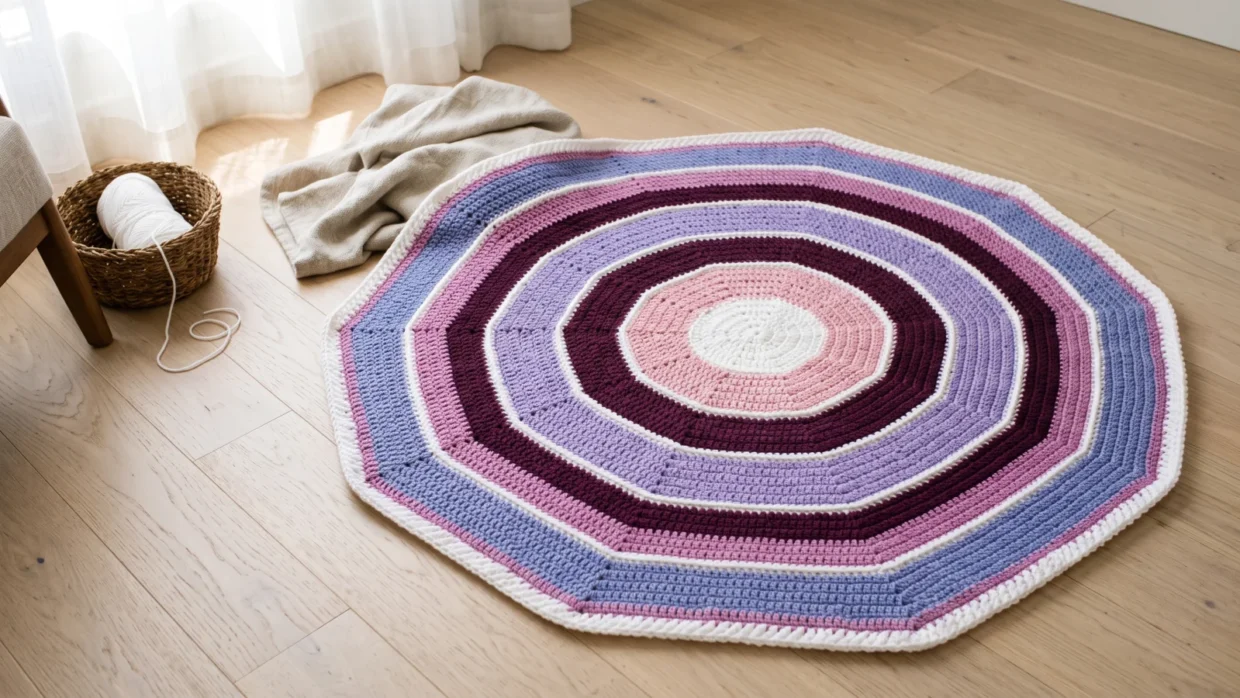
The finished blanket laid flat, with a white center and bands of soft pink, plum wine, orchid and lavender blue
Pattern at a Glance
- Skill level
- Easy
- Yarn weight
- Worsted (#4)
- Yarn brand
- Simply Soft
- Hook size
- Size to match gauge
- Finished size
- 41 in / 104 cm diameter
- Yarn needed
- 5 skeins, 315 yd (288 m) each
- Construction
- Worked in joined rounds from a center ring
- Stitches
- Chain, slip stitch, single crochet, half double crochet, double crochet, dc2tog, hdc2tog, reverse single crochet
- Gauge
- 16 sts and 7 rows = 4 in (10 cm) in double crochet
- Pattern type
- Written pattern
- Project type
- Baby blanket
If you want crochet newborn blanket patterns written out in full, this page gives you one complete design, from the first chain to the last stitch. The blanket starts from a small ring and grows outward in rounds, finishing at 41 in (104 cm) across. Every round ends with a stitch count so you can check your work as you go.
Pattern at a Glance
- Finished size: 41 in (104 cm) in diameter
- Yarn: Simply Soft in five colors, one skein of each
- Gauge: 16 sts and 7 rows = 4 in (10 cm) in double crochet
- Construction: joined rounds from a center ring, 37 rounds plus a 2-round border
- Optional: embroidered lazy daisy petals at the center
Finished Size
The blanket measures 41 in (104 cm) across. That is wide enough to cover a newborn from head to toe with fabric left over to tuck, and still small enough to fold up and carry. Because it is round, there is no long side to drag, and it stays useful as the baby grows, as a lap blanket or a mat for supervised floor play.
If you need a different dimension, the full baby blanket size guide covers other sizes. This design can also be stopped early, as the FAQ explains.
Yarn, Hook and Notions
This blanket uses Simply Soft, a worsted-weight (#4) acrylic yarn, in five colors. Each skein is 6 oz (170 g) and 315 yd (288 m), and you need one skein of each color: 1,575 yd (1,440 m) in total.
| Letter | Color | Shade number | Skeins |
|---|---|---|---|
| A | White | 9701 | 1 |
| B | Soft Pink | 9719 | 1 |
| C | Plum Wine | 9722 | 1 |
| D | Orchid | 9717 | 1 |
| E | Lavender Blue | 9756 | 1 |
The instructions refer to colors by letter, so I would label each skein A to E before you begin. To plan yarn for other blanket sizes, see how much yarn a crochet blanket needs.
- Hook: the size that gives you the gauge below
- Yarn needle: for weaving in ends and the optional embroidery
- Pins and a spray bottle of water: for finishing
- Stitch markers: optional, but useful for marking corners
Choosing and substituting yarn for a newborn
For a newborn I would choose yarn that is soft, smooth and machine washable, because the blanket will be laundered often. A smooth, tightly plied yarn also shows stitch definition and is less likely to catch tiny fingers than a fuzzy or loosely spun one. Read the care label before you buy.
If you substitute, check three things: the yarn is worsted weight (#4), each skein has at least 315 yd (288 m) for its color, and you can match the gauge below. Pale, fuzzy yarns hide stitches, so work in good light and count carefully at the corners.
Use any baby blanket according to your pediatrician’s guidance, especially around sleep. This page makes no safety claims; whether crochet blankets are safe for babies covers the question properly.
Gauge
In double crochet, 16 stitches and 7 rows = 4 in (10 cm).
On a blanket, gauge is not a fit issue, so small differences are forgivable. What changes is size and yarn use: a looser gauge gives a larger blanket that uses more yarn and may ruffle at the edge, while a tighter gauge gives a smaller, firmer one. Since each color is a single skein, I would still swatch: work a square in double crochet, measure across the middle 4 in, and change hook size until you match.
Skill Level and Techniques
I would rate this Easy. Every stitch is basic, and the only shaping is the corner placement and the paired decreases written into the rounds. You should be comfortable with:
- Working into a ring and joining rounds with a slip stitch
- Working into chain spaces, including (dc, ch 2, dc) corners
- Decreasing with dc2tog and hdc2tog over a chain
- Changing color and fastening off at the end of rounds
- Reverse single crochet for the edge
The real demand is stamina and counting: 37 rounds, eight corners each, in several colors. Checking your count at the end of every round is what keeps the corners lined up.
Abbreviations and Terms
This pattern uses US crochet terminology throughout.
- ch(s): chain(s)
- sl st: slip stitch
- sc: single crochet
- hdc: half double crochet
- dc: double crochet
- dc2tog: (yarn over, draw up a loop in next st, yarn over and draw through 2 loops on hook) twice, then yarn over and draw through all loops on hook
- hdc2tog: (yarn over, draw up a loop in next st) twice, then yarn over and draw through all loops on hook
- rev sc: reverse single crochet, worked from left to right (right-handed): insert hook in the next stitch to the right, draw up a loop, yarn over and draw through both loops
- rnd(s), sk, sp, st(s), rep, yoh: round(s), skip, space, stitch(es), repeat, yarn over hook
If you use UK terms, US dc is UK treble (tr), US hdc is UK half treble (htr), and US sc is UK double crochet (dc).
How the Blanket Is Built
Every round is made of eight groups of double crochet separated by corner chain spaces. Most rounds add two stitches to each group, which raises the count by 16. In Rnds 10 and 13, and their repeats, decreases at each corner keep the count steady so the blanket does not flare. Rnds 10–16 are a seven-round repeat in a fixed color order. Counts below include only dc or hdc, never chain spaces.
| Rounds | Colors | Stitch count at end of each round |
|---|---|---|
| 1–3 | A | 8, 16, 24 |
| 4–5 | B | 40, 56 |
| 6 | C | 72 |
| 7–8 | D | 88, 104 |
| 9 | E | 120 |
| 10–16 | A, B, B, C, D, D, E | 120, 136, 152, 152, 168, 184, 200 |
| 17–23 | A, B, B, C, D, D, E | 200, 216, 232, 232, 248, 264, 280 |
| 24–30 | A, B, B, C, D, D, E | 280, 296, 312, 312, 328, 344, 360 |
| 31–37 | A, B, B, C, D, D, E | 360, 376, 392, 392, 408, 424, 440 |
| Border | A | 448, 448 |
Crochet Newborn Blanket Pattern Instructions
Before you start: the ch 3 at the beginning of a dc round counts as the first dc. In Rnd 10 and its repeats, the ch 2 does not count as a stitch, so work the first hdc into the dc where you joined. A ‘corner’ is always a ch-2 space.
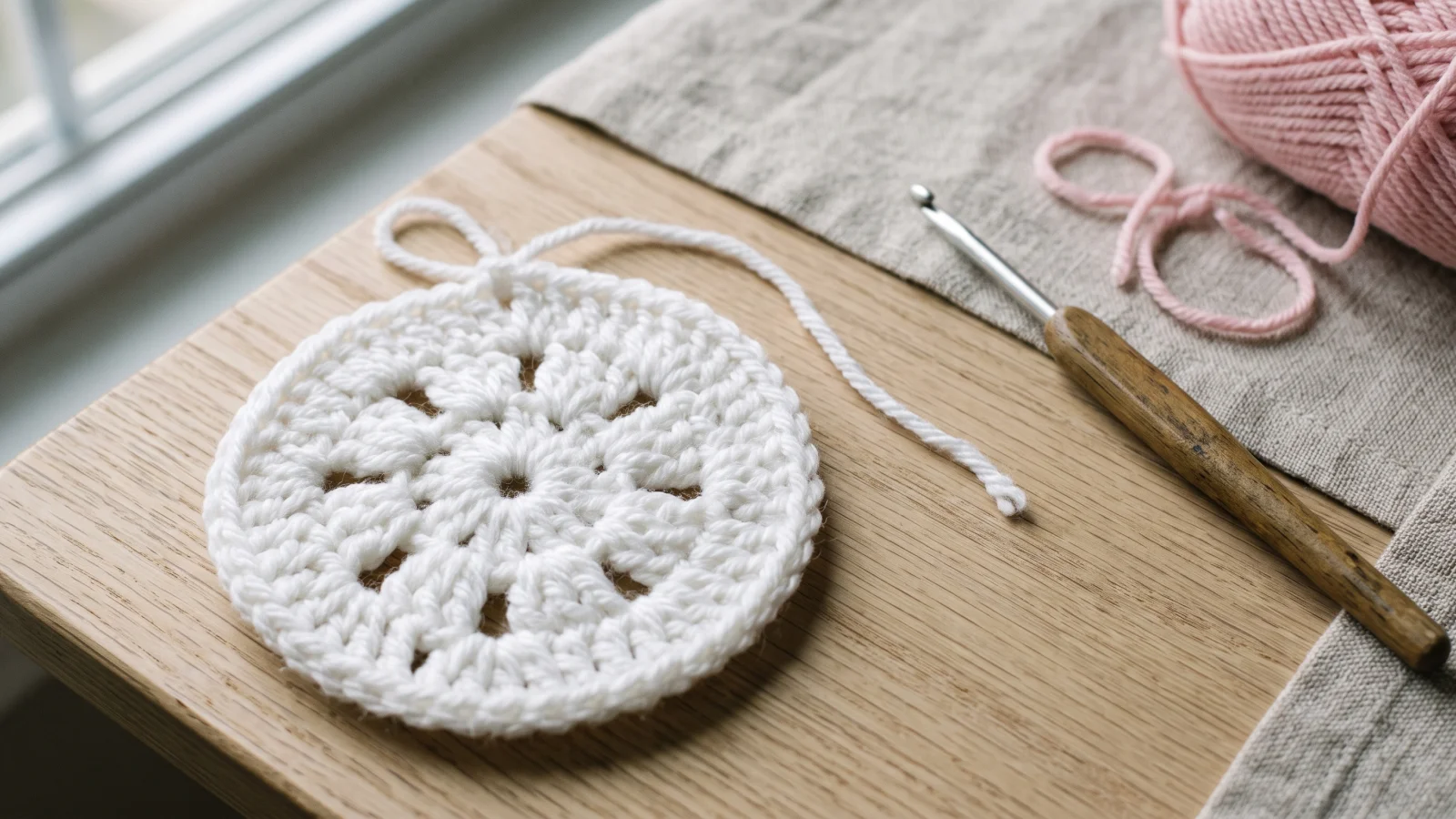
Center: Rnds 1–3
Rnd 1: With A, ch 5 and join with a sl st in the first ch to form a ring. Ch 1, work 8 sc in the ring; join with a sl st in the first sc. (8 sc)
Rnd 2: Ch 3 (counts as first dc here and throughout), dc in the same sc as the join, 2 dc in each sc around; join with a sl st in the top of the beginning ch 3. (16 dc)
Rnd 3: Ch 3, 2 dc in the same dc as the join, ch 1, sk next dc, *3 dc in the next dc, ch 1, sk next dc; rep from * around; join with a sl st in the top of the beginning ch 3. Fasten off. (24 dc: eight 3-dc groups)
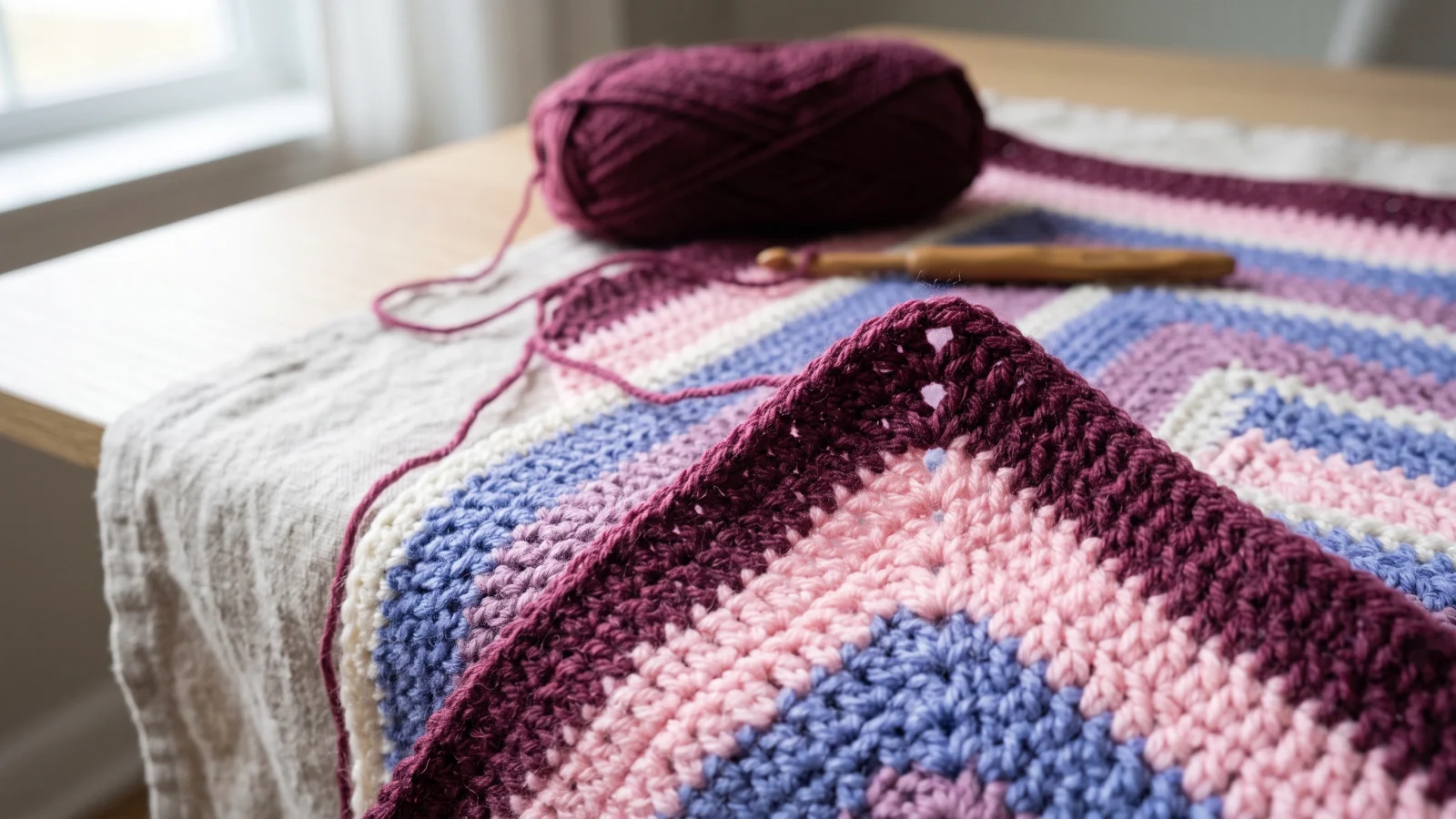
Corner rounds: Rnds 4–9
Rnd 4: Join B with a sl st in any ch-1 sp. Ch 3, dc in each st to the next ch-sp, *(dc, ch 2, dc) in the next ch-sp, dc in each st to the next ch-sp; rep from * around, dc in the same ch-sp as the join, ch 2; join with a sl st in the top of the beginning ch 3. (40 dc: eight 5-dc groups)
Rnd 5: With B, ch 3, dc in each dc to the next ch-sp, *(dc, ch 2, dc) in the next ch-sp, dc in each dc to the next ch-sp; rep from * around, dc in the same ch-sp as the join, ch 2; join with a sl st in the top of the beginning ch 3. Fasten off. (56 dc: eight 7-dc groups)
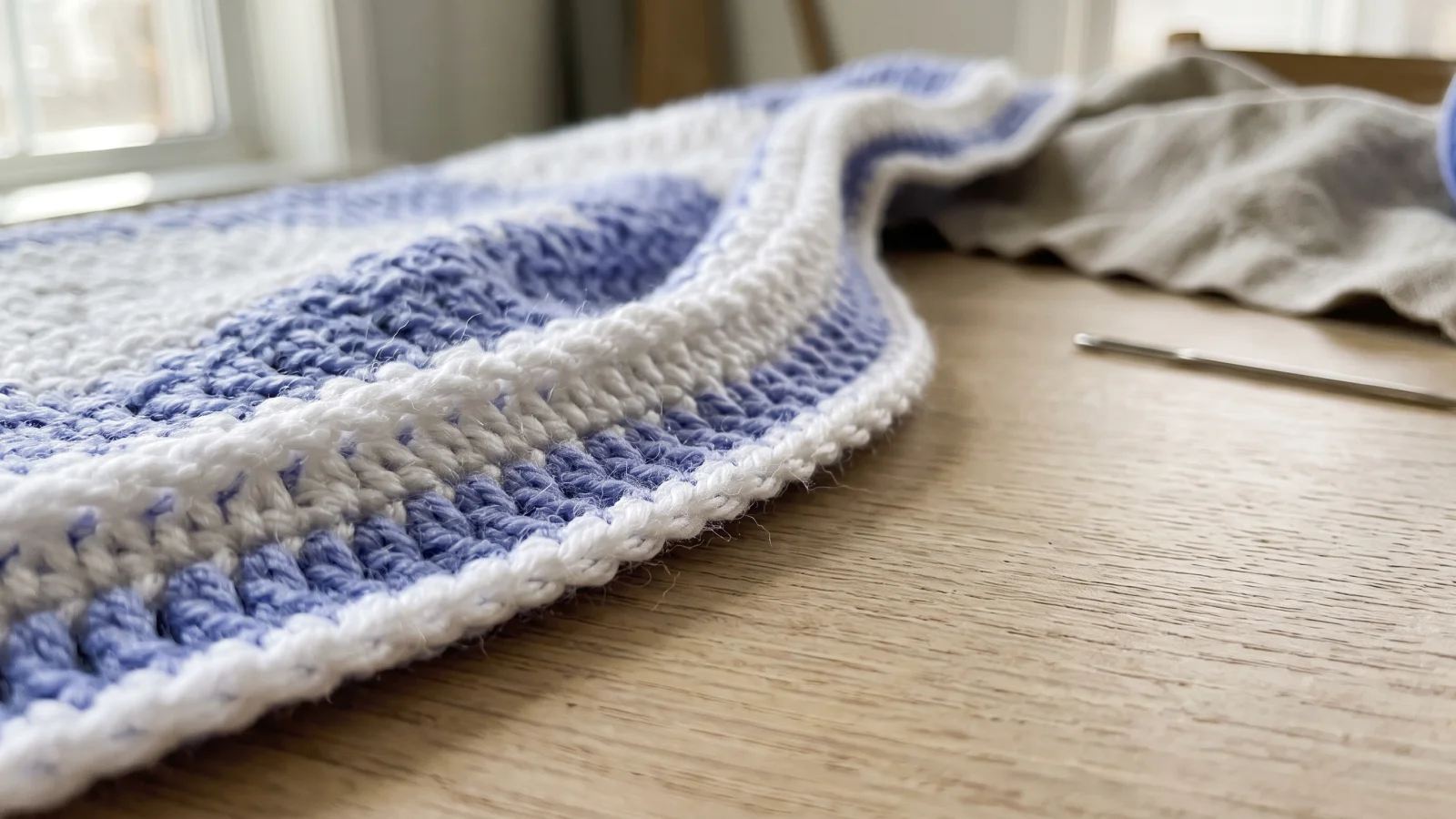
Rnd 6: Join C in any ch-sp and work as Rnd 4. Fasten off. (72 dc: eight 9-dc groups)
Rnds 7–8: Join D in any ch-sp, work Rnd 4, then work Rnd 5 in the same color. Fasten off. (Rnd 7: 88 dc; Rnd 8: 104 dc, eight 13-dc groups)
Rnd 9: Join E in any ch-sp and work as Rnd 4. Fasten off. (120 dc: eight 15-dc groups)
First repeat: Rnds 10–16
Rnd 10: Join A with a sl st in any dc between corners (not a dc of a corner), ch 2. [Hdc in each dc to 1 dc before the next ch-2 sp, hdc2tog over the next dc and the first ch of the ch-2 sp, ch 2, hdc2tog over the 2nd ch of the ch-2 sp and the next dc] 8 times, hdc in each remaining dc around; join with a sl st in the first hdc. Fasten off. (120 hdc: eight 15-hdc groups)
Rnds 11–12: Join B in any ch-sp, work Rnd 4, then work Rnd 5. Fasten off. (Rnd 11: 136 dc; Rnd 12: 152 dc, eight 19-dc groups)
Rnd 13: Join C with a sl st in any dc between corners (not a dc of a corner), ch 3. [Dc in each dc to 1 dc before the next ch-2 sp, dc2tog over the next dc and the first ch of the ch-2 sp, ch 2, dc2tog over the 2nd ch of the ch-2 sp and the next dc] 8 times, dc in each remaining dc around; join with a sl st in the top of the beginning ch 3. Fasten off. (152 dc: eight 19-dc groups)
Rnds 14–15: Join D in any ch-sp, work Rnd 4, then work Rnd 5. Fasten off. (Rnd 14: 168 dc; Rnd 15: 184 dc, eight 23-dc groups)
Rnd 16: Join E in any ch-sp and work as Rnd 4. Fasten off. (200 dc: eight 25-dc groups)
Remaining repeats: Rnds 17–37
Work Rnds 10–16 three more times, 21 rounds in all, keeping the color order A, B, B, C, D, D, E. Counts: Rnds 17–23 are 200, 216, 232, 232, 248, 264 and 280 sts. Rnds 24–30 are 280, 296, 312, 312, 328, 344 and 360 sts. Rnds 31–37 are 360, 376, 392, 392, 408, 424 and 440 sts. Fasten off. (Rnd 37: 440 dc, eight 55-dc groups)
Border
Rnd 1: Join A with a sc in any dc of the last round, work 1 sc in each dc and each ch-2 sp around; join with a sl st in the first sc. (448 sc)
Rnd 2: With A, rev sc in each sc around; join with a sl st in the first st. Fasten off. (448 rev sc)
Finishing and Care
Weave in all ends with a yarn needle. Lay the blanket flat, pin each corner in place, spray with water and let it dry. For a flatter finish, see how to block a crocheted blanket. Wash and dry according to the label on your yarn.
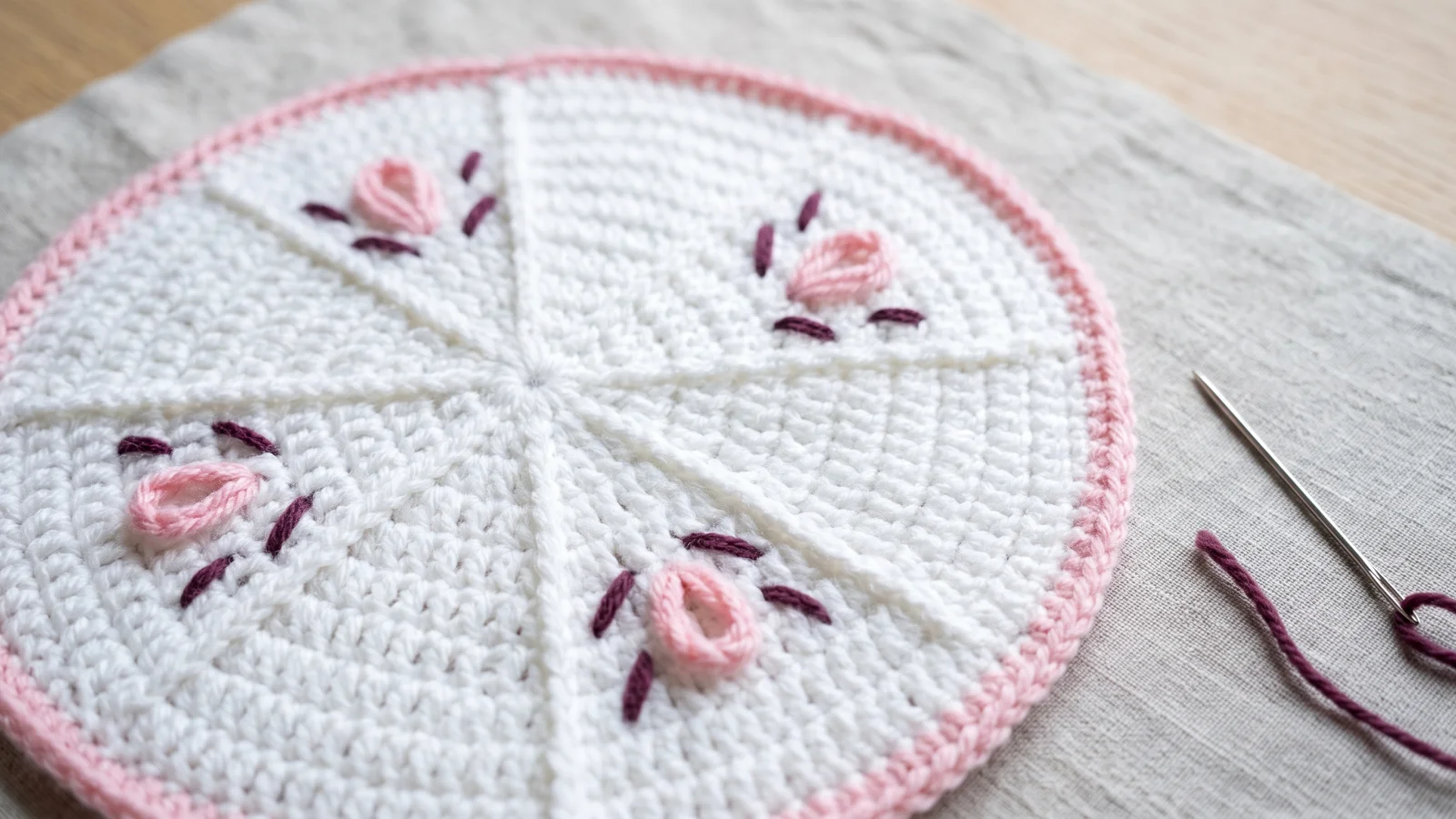
Optional embroidery
With B, embroider one lazy daisy petal on every other A-colored section at the center, four petals in all. With C, add a diagonal straight stitch on either side of each petal. For a lazy daisy, bring the needle up at the base, hold the yarn in a loop, go back down beside that point and come up at the petal tip inside the loop, then anchor with a tiny stitch.
Embroidery leaves loops on the surface, so on a blanket for a very young baby I would anchor every stitch firmly or leave it out.
Color Ideas
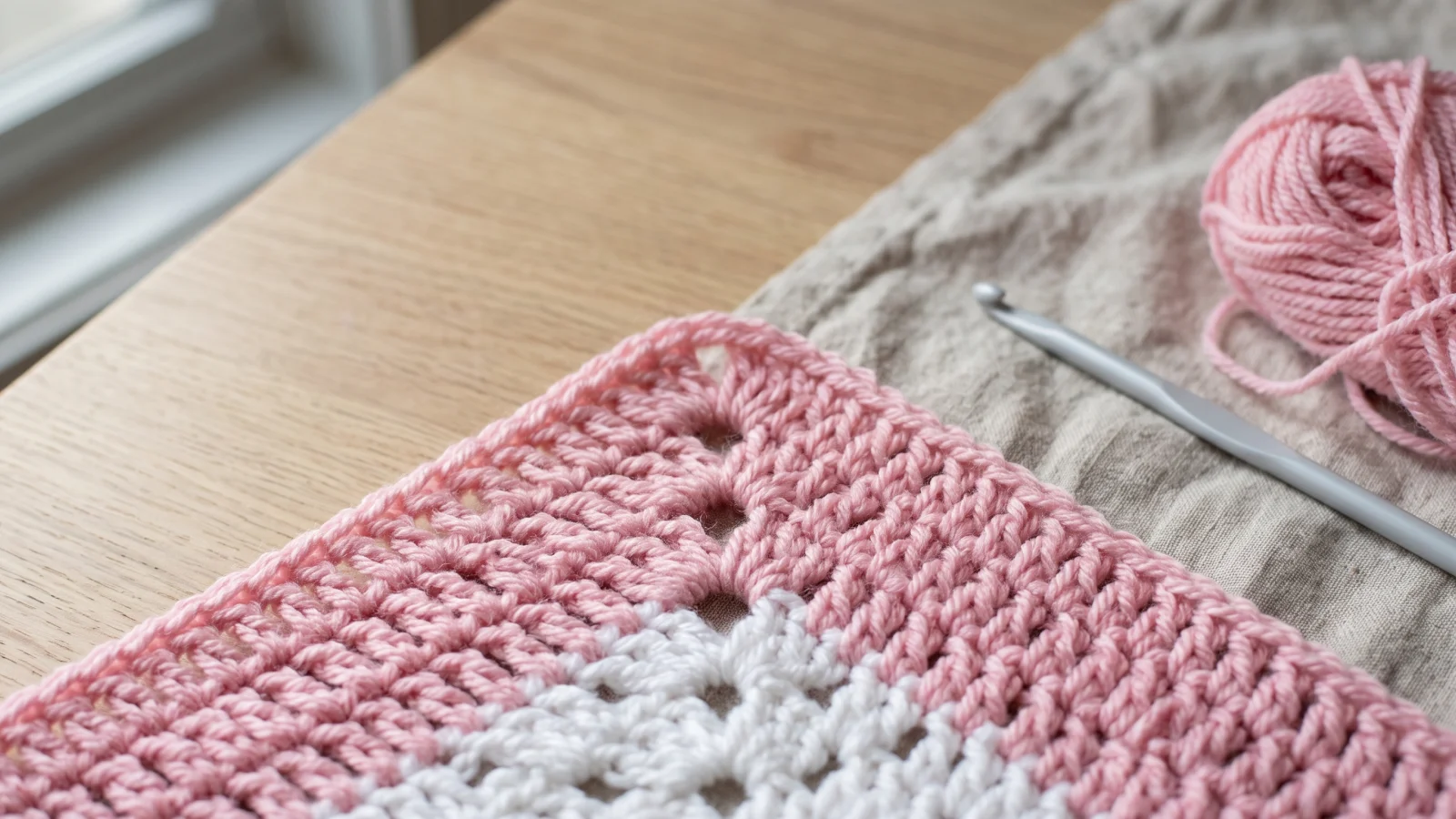
These are variations, not part of the pattern as written. What makes the rings read clearly is contrast: A is a light neutral separating the other colors, and B, C, D and E step from soft to deep. For a more gender-neutral or boy-leaning blanket, I would swap B to E for blues, grays or sage greens, matching each replacement to the lightness of the color it replaces. Keep the same yarn weight and yardage per skein, and match the gauge.
Troubleshooting
- Corners drift or look uneven: recount against the table. The usual cause is a missed or doubled dc next to a corner. A marker in each ch-2 corner helps.
- Edge ruffles: the usual causes are loose tension, a hook that is too large, or skipped decreases in Rnds 10 and 13 and their repeats. Work every hdc2tog and dc2tog as written.
- Blanket cups or curls: tension is probably too tight or stitches are missing. Check counts, then go up a hook size.
- Fabric feels stiff: relax your tension or move up a hook size, and re-swatch to confirm the gauge.
- Running short of yarn: a loose gauge uses yarn faster. A is also needed for the border, so keep a good amount of it back.
- Stitches hard to see: work in daylight and count at the end of every round.
Frequently Asked Questions
What size should a crochet newborn blanket be?
This one is 41 in (104 cm) across. See the baby blanket sizes and stitch planning guide for others.
How much yarn do I need?
One 315 yd (288 m) skein in each of five colors, 1,575 yd (1,440 m) altogether.
What is the best yarn for a newborn blanket?
A soft, smooth, machine-washable worsted yarn. This pattern uses Simply Soft.
Can I make this blanket bigger or smaller?
You can stop after a complete seven-round repeat, then work the border. By gauge, each repeat adds about 4 in to the radius, so stopping after Rnd 30 should give roughly 33 in and after Rnd 23 roughly 25 in. These are estimates, so measure as you go. A larger blanket needs more yarn than the five skeins.
Is a crochet blanket safe for a newborn?
Follow your pediatrician’s guidance, especially for sleep. Read baby blanket safety guidance for more.
Which colors work for a boy, girl or gender-neutral blanket?
The colors as written lean soft pink and purple. For other looks, see Color Ideas above.
How do I wash it?
Follow the care label on your yarn.
Do I need to block it?
The finish used here is pinning the corners, spraying with water and letting it dry. For more, see blocking your finished blanket.
Related Reading
Looking for something different? Try more newborn blanket pattern ideas or another newborn blanket pattern with a yarn guide.

Last updated . Found something out of date? Let us know.