 Accessories
 Baby & Kids
 Blankets & Afghans
 Clothing
Crochet Newborn Blanket Patterns: Free Options and How to Choose One
Crochet newborn blanket patterns don't come with a fixed size. “Newborn” describes how a blanket will be used, and published newborn and receiving sizes run from roughly 30 to 40 inches across.
 Nicole Sinclair
Published · Updated · 15 min read
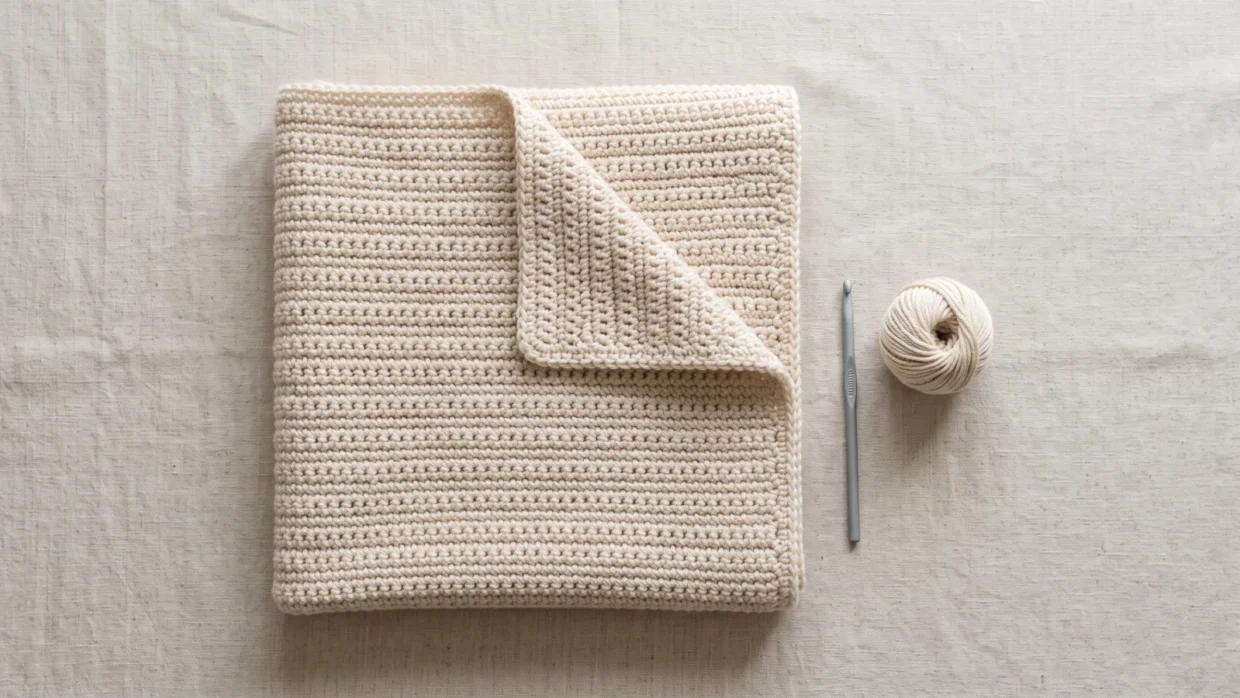
A finished cream single crochet baby blanket folded on a linen surface beside a ball of matching worsted-weight yarn and a crochet hook
Search for crochet newborn blanket patterns and you get three different things mixed together: blankets sized for the first weeks, general baby blankets that also fit a stroller or crib, and toddler throws with “baby” in the title. No industry standard defines a newborn blanket, so the word in a pattern name tells you how the designer expects the blanket to be used. It does not tell you how big it is. The finished-size line and the gauge tell you that.
This roundup does two jobs. It compares five free patterns using the specs their designers and brands publish (checked in September 2026), and it gives you a way to test any other pattern, including ones not listed here, before you spend money on yarn. I left out patterns that don’t publish both a finished size and a hook size, because you can’t compare what isn’t stated.
Newborn blanket or baby blanket? It comes down to use
In the size guides and pattern listings behind this roundup, blankets labeled newborn or receiving run from about 30 to 40 inches square, stroller blankets sit near 30 × 35 inches, and crib blankets start around 36 × 52 inches. Those labels overlap, so I treat them as a statement of purpose and go straight to the finished-size line.
| Name you will see | Range in published guides and patterns | What it is usually meant for |
|---|---|---|
| Lovey or security blanket | About 10–20 in square | A small piece for a baby to hold. The least yarn and the least commitment. |
| Car seat or cradle | About 14 × 30 to 20 × 24 in | Small coverage. Sizes vary more here than anywhere else. |
| Newborn or receiving | About 30–40 in square | Wrapping, lap, and play-mat use in the first weeks. Patterns that say “newborn” tend to sit at the small end. |
| Swaddle-size | About 47–48 in square | A large square sized for wrapping. It is a dimension label, not a safety claim. |
| Stroller or pram | About 22–30 × 30–44 in; 30 × 35 is common | Covers a baby in a stroller without dragging into the wheels. |
| Crib or cot | About 30 × 40 to 45 × 60 in; 36 × 52 is common in crochet guides | Sized to suit a crib. Also used as a floor or play blanket. |
| Toddler | About 36 × 44 to 42 × 48 in | Extends the blanket’s use past the baby stage. |
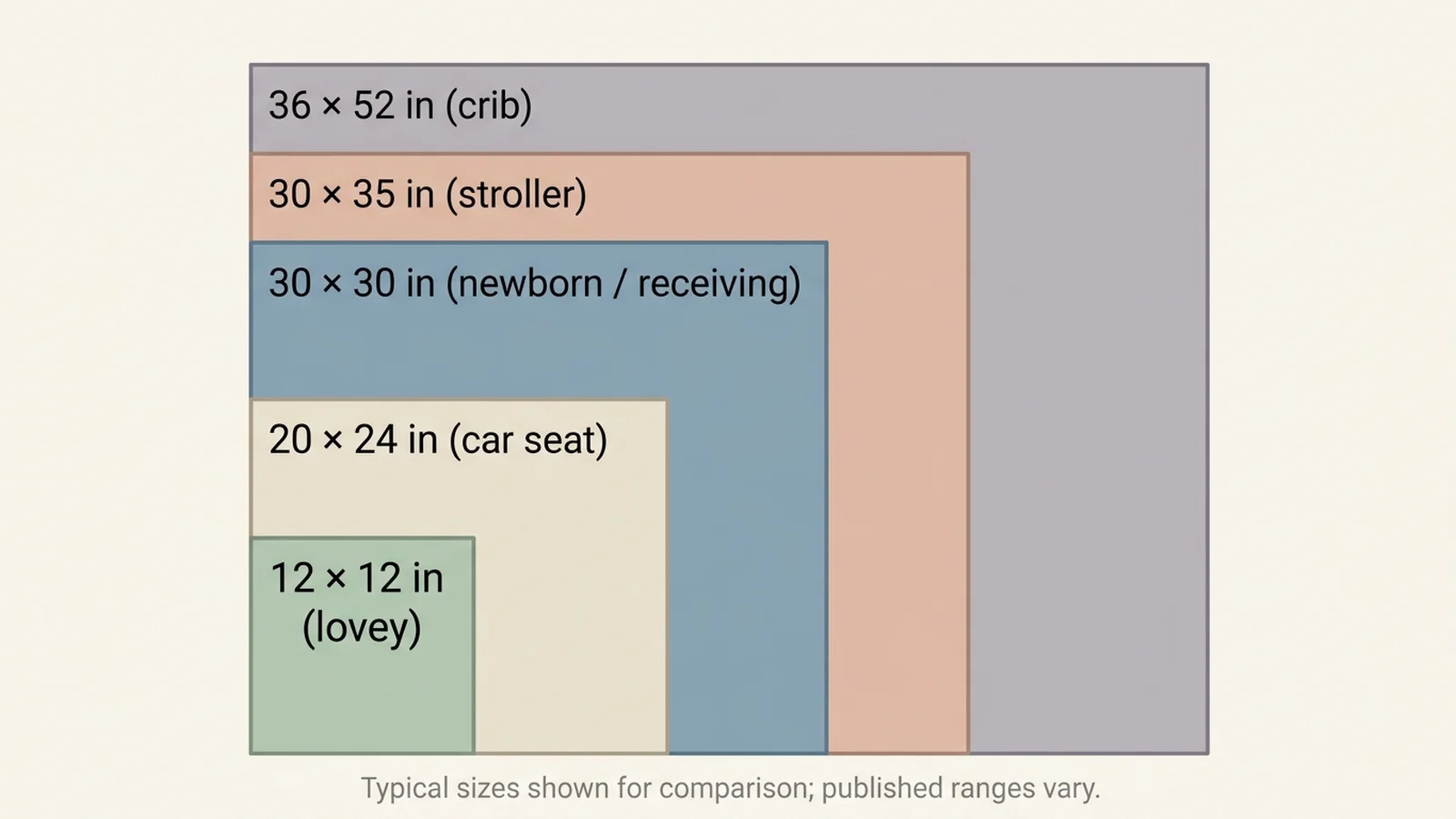
These ranges are compiled from published baby-blanket size guides and pattern listings. They are not a standard, so use them to decide what you are aiming for, not to judge a pattern that lands a few inches outside them.
A quick translation for patterns from the UK: a crib is a cot, and a stroller is a pram or pushchair. UK patterns often give centimeters. A 65 cm pram blanket is about 26 inches square, and a cot blanket of roughly 90 × 110 cm is about 35 × 43 inches. This article uses US crochet terms throughout: sc = single crochet, dc = double crochet, ch = chain, sts = stitches. If you meet a UK pattern, US dc is UK treble crochet, and US sc is UK double crochet.
Treat two labels with suspicion: “baby blanket” with no dimensions, and any size name used on its own. One free pattern that lists three sample sizes describes its preemie blanket at about 26 × 34 inches and its newborn/receiving blanket at about 30 inches square. The two cover almost the same area. If you are making blankets for a hospital or NICU, ask for its size and fiber requirements first, because they are set by the unit.
Crochet newborn blanket patterns compared
Every figure below comes from the designer’s or brand’s own page or PDF. Where a detail is missing or the listing contradicts itself, the table says so instead of guessing.
| Pattern | Finished size | Stitches | Yarn weight and hook | Yarn amount | Published skill label |
|---|---|---|---|---|---|
| Elise’s Single Crochet Blanket (Easy Crochet) | About 35 × 30 in (free version is one size) | Chain, single crochet | Worsted (#4); 4.5 mm | About 1,006 yd | Basic |
| Easy Crochet Baby Blanket, the Picket Fence Baby Blanket (Daisy Cottage Designs) | About 30 in square | Chain, double crochet; optional border adds single crochet and half double crochet | Worsted (#4); 6.0 mm (J/10) | Just over 700 yd (2 skeins in the sample) | Described as beginner-friendly |
| With Love Modern Moss Stitch Baby Blanket (Daisy Farm Crafts) | 32 × 37 in | Chain, single crochet, slip stitch | Worsted (#4); 6.5 mm (K/10½) | 2 skeins main color plus 1 contrast, 370 yd per skein | Not labeled; designer suggests it for new crocheters |
| Baby Comfort Blanket (Red Heart, via Yarnspirations) | 36 × 36 in | Chain, double crochet, 3-dc cluster, crossed double crochet, single crochet, shell border | Red Heart Super Saver (worsted); 5.5 mm (I-9) | 3 skeins, 364 yd each in solid colors | PDF says Easy; product page says Intermediate |
| Fast Easy Crochet Baby Blanket (Amy Solovay, write-up on Daily Crochet) | Preemie about 26 × 34 in; newborn/receiving about 30 in square; toddler about 36 × 44 in | Chain, single crochet | Sample in Bernat Softee Baby (labeled DK, #3); hook listing is inconsistent | About 724 yd for the preemie sample; 2–3 five-ounce balls for newborn; 4 for toddler | Beginner |
Elise’s Single Crochet Blanket: the fewest decisions
Elise’s Single Crochet Blanket is the most fully specified pattern here. The free version is a chain of 105, then 104 sc in every row for 131 rows, with a stated gauge of 14 sts and 15 rows in 4 inches and no border. The free page covers the stroller size only, and a multi-size PDF is sold separately. Watch for: 131 identical rows are easy to miscount, so I would place a stitch marker every 10 rows. Solid single crochet is also denser than the other fabrics here, so yarn softness matters more.
Picket Fence Baby Blanket: the fastest finish
Daisy Cottage Designs’ Easy Crochet Baby Blanket alternates a solid dc row with a mesh row (dc in three stitches, ch 1, skip one), starting from a chain of 100 and working 57 rows. The gauge is 13 sts and 8 rows in 4 inches. The designer wrote it without a border to keep the lines clean, and gives an optional sc round plus a picot edging. Watch for: the row 1 count of 99 includes the beginning chain-2 as a stitch, but the chain-1 turns in later rows do not count. That difference is a likely source of a count that comes out one short.
With Love Modern Moss Stitch Baby Blanket: modern texture, simple stitches
This Daisy Farm Crafts pattern is also a Red Heart pattern on Yarnspirations. It works sc and ch 1 across from a chain of 100, and the designer says any even number of chains resizes it. The stripe sequence is nine rows of the main color, one contrast row, three main rows, and one contrast row, repeated. Watch for: moss stitch depends on placing each sc into the previous row’s space, so a missed space quietly changes the width. The border is the harder part, because its second round builds a chain-8 band worked in the back loops.
Baby Comfort Blanket: a textured keepsake for your second or third blanket
Red Heart’s Baby Comfort Blanket is 36 × 36 inches and worked from a chain of 103, with the foundation chain worked in the back bottom loop. Its gauge is stated as 3 clusters and 2 crossed dc in 4 inches, with 6 rows in 4 inches. The PDF labels it Easy, while the product page tags it Intermediate. I would go by the stitch list: clusters, crossed dc, and a four-round shell border with corner counts make it more than a first project. Watch for: the border is built around 100 sc per side, so changing the size means recalculating it.
Fast Easy Crochet Baby Blanket: three sizes, but confirm the materials
The Daily Crochet write-up of Amy Solovay’s pattern is useful because it gives preemie, newborn/receiving, and toddler samples in one place. It also contradicts itself. One materials list names worsted and bulky yarn with an H/8 (5 mm) hook, while another section describes a DK-weight (#3) sample yarn and an I hook. The full written pattern is hosted elsewhere, so open it and swatch before you commit to yarn.
How to choose a newborn blanket pattern
Start with what the blanket will do, then let the finished size, gauge, and yardage confirm that the pattern fits.
- Decide the use first. A stroller or car seat blanket wants about 30 × 35 inches or less. A play-mat or keepsake blanket can be larger. Use the size table above, not the word “newborn.”
- Find the finished size and the gauge on the same page. If either is missing, treat the stated size as unverified until you swatch.
- Check yardage against size. If yardage is missing, estimate it using the method in the troubleshooting section below.
- Read the stitch list, not the skill label. Count the different stitches and techniques, including the border.
- Look at how open the fabric is. Chain-1 gaps read as airy. Solid single crochet is denser.
Here is how I would match the five patterns to the reader:
- First blanket, want every number checkable: Elise’s Single Crochet Blanket. One stitch, stated gauge, and a stitch count for every row.
- Fastest finish, comfortable with a few small gaps: the Picket Fence Baby Blanket. Double crochet is taller, so it has just 57 rows.
- A modern look with simple stitches: the With Love Modern Moss Stitch Baby Blanket. The stripes add color-change steps, and I would keep the border simple on a first attempt.
- A more traditional textured blanket, past your first project: Baby Comfort Blanket.
- Several size options in one pattern: the Fast Easy Crochet Baby Blanket, after you have checked its materials against the original.
If you want a pattern written around beginner skills, see our easy baby blanket crochet pattern. For more detail on dimensions than the table above gives, our crochet baby blanket size guide covers it.
Check any pattern’s size with its own gauge
Gauge is the number of stitches and rows in 4 inches. Divide the pattern’s stitch count by its stitches per 4 inches, then multiply by 4. Elise’s blanket makes a clean example: 104 sts ÷ 14 × 4 is about 29.7 inches wide, and 131 rows ÷ 15 × 4 is about 34.9 inches long. That matches the published 35 × 30 inches, so the pattern is internally consistent.
When the numbers disagree, or gauge is missing, the stated size is only the designer’s result at their own tension. On a flexible blanket a gauge miss usually changes the dimensions rather than ruining the project. If your swatch gives 13 sts per 4 inches instead of 14, the same 104 sts make a blanket about 32 inches wide, roughly 2 inches wider than intended.
Easy, modern, free, gender-neutral: what those labels mean
- Easy is about how many decisions a pattern asks of you, not how it looks. Elise’s uses one stitch. Baby Comfort uses several stitch types and a four-round border, whichever label it carries.
- Modern usually means clean edges, a limited palette, and little ornament. The Picket Fence blanket is written without a border for that reason. A moss stitch blanket with one contrast stripe gets a similar look with more texture.
- Free deserves a second look at what is free. Elise’s free page covers one size, and additional sizes are in a paid PDF. Daisy Cottage Designs sells an ad-free PDF, but the pattern on its page is free. Yarnspirations puts the finished size in the downloadable PDF instead of on the product page.
- Gender-neutral is a colorway decision, not a pattern feature. Any solid-color pattern here works in cream, oatmeal, sage, gray, or soft yellow. For the moss pattern, pick two colors that pair well and aren’t tied to a stereotype.
Choosing yarn and hook for a newborn blanket
Four of the five patterns above are written for worsted-weight (#4) yarn, and the fifth’s sample yarn is labeled DK (#3). Hook size is the bigger variable. The worsted patterns range from 4.5 mm to 6.5 mm, and that range changes how firm or open the fabric feels far more than the yarn brand does.
Solid, mesh, or moss: how open should the fabric be?
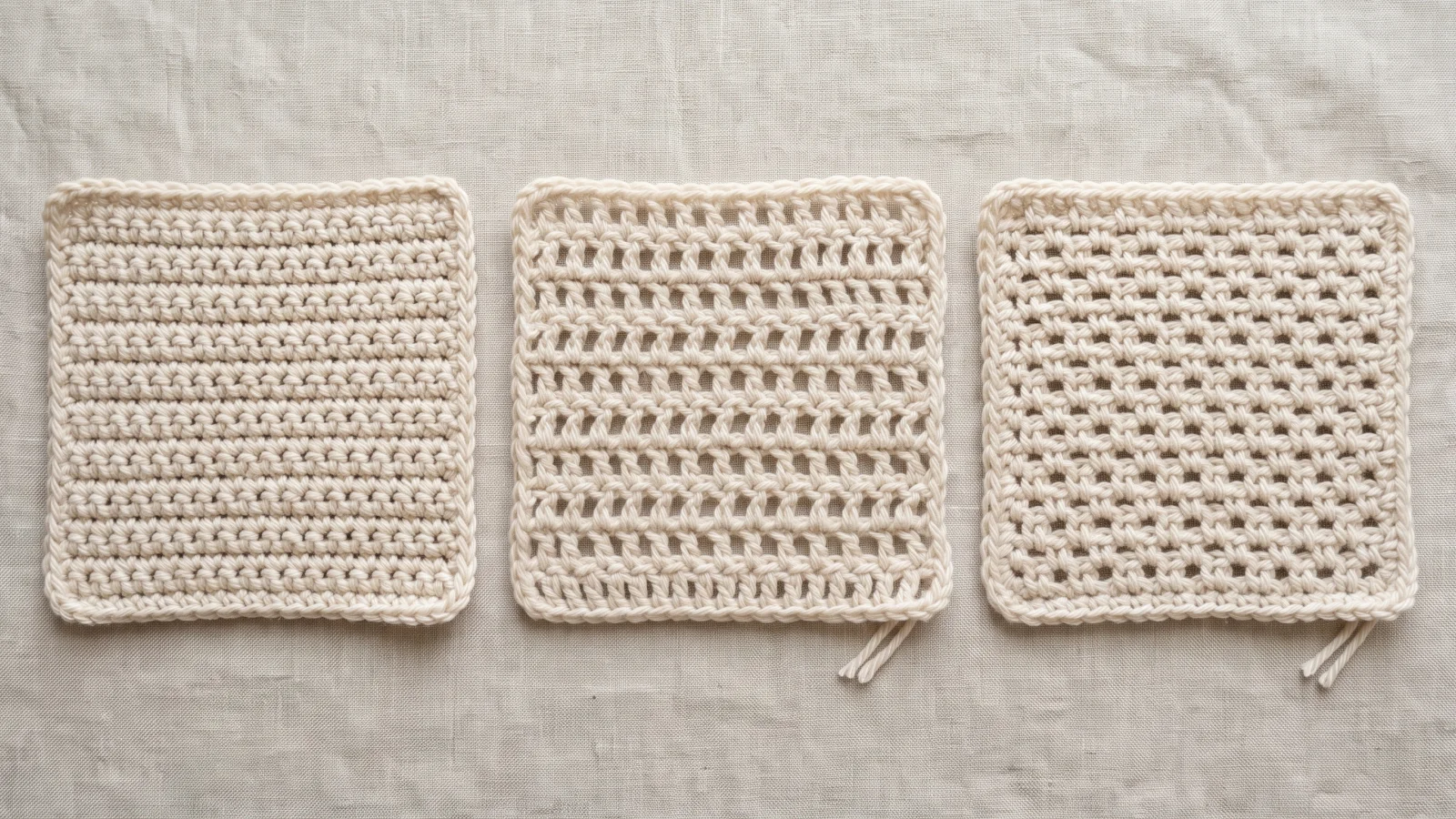
Elise’s is a solid single crochet fabric. The Picket Fence blanket puts a chain-1 gap after every third dc in its mesh rows, and the moss and cluster designs build chain-1 spaces into the fabric. Small gaps are normal in baby blankets, but very open lacework can catch small fingers and toes. For a newborn I would lean toward the denser fabrics and save airy designs for photos and occasional use.
- Match gauge, not brand. A different yarn in the same weight can still land on a different gauge. Swatch before you cast on.
- Compare yards, not skeins. Red Heart Super Saver solid skeins are 364 yd, and Red Heart With Love skeins are 370 yd. Those are close, but skein sizes differ across lines, so buy by total yardage.
- Buy all the yarn for a solid color at once. A dye-lot shift halfway down a blanket is very visible.
- Fiber is a trade-off. Cotton generally has less stretch and gives more structure. Acrylic is generally springier. Pick by how you will wash the blanket and how drapey you want it.
- Skip hairy, sparkly, or metallic yarns for a newborn blanket, and skip sewn-on decorations.
- Follow the ball band for care. As an example, the Baby Comfort page lists machine wash warm on a gentle cycle, tumble dry low, no bleach, no iron, for its Super Saver yarn. If you are giving the blanket as a gift, include the care label.
Resizing a newborn blanket pattern
Row-based blankets resize easily, because width is the foundation chain and length is the number of rows. Work from your own gauge: stitches per inch is the stitches per 4 inches divided by 4. The examples below use each designer’s published gauge and yardage, scaled by area. They are starting estimates, so swatch to confirm.
| Pattern | Goal | Foundation chain | Rows | Yarn estimate |
|---|---|---|---|---|
| Elise’s Single Crochet Blanket | About 40 × 40 in | Ch 141 (140 sc per row) | 150 rows | About 1,550 yd; about 1,700 yd with a 10% buffer |
| Picket Fence Baby Blanket | About 36.5 × 36.5 in | Ch 120 (119 sts per row) | 73 rows, ending on a solid row | About 1,050 yd; about 1,150 yd with a 10% buffer |
For Elise’s blanket, chain = width in inches × 3.5, plus 1. Rows = length in inches × 3.75. For the Picket Fence blanket, keep the chain a multiple of 4 and the total row count odd, so you end on a solid row. Those yarn figures work out to roughly 0.96 yd per square inch for Elise’s and about 0.8 for Picket Fence. That is why the open mesh uses less yarn than solid single crochet.
The moss stitch designer says to chain any even number. On the Baby Comfort blanket the chain is 5 × the number of clusters + 3, and the border is built around 100 sc per side. I would not resize that one on a first attempt.
Borders, finishing, and care
- Border effort ranges from none to four rounds. Elise’s has no border. Picket Fence has one optional sc round with 3 sc in each corner, plus a picot edging. The moss blanket has two rounds, and Baby Comfort has a four-round shell border.
- A border won’t repair a widening edge. A missing edge stitch can gradually change the width, so count the stitches at the end of the row now and then.
- Weave ends in two directions. Split the yarn as you go so nothing works loose in the wash.
- Skip buttons, ribbons, tassels, and sewn-on embellishments on a newborn blanket.
- Block if the edges curl. Pinning the blanket out damp to its measurements helps it lie flat.
Fixing unclear patterns before you buy yarn
| Problem | What to check | What I would do |
|---|---|---|
| Finished dimensions are unclear | Gauge and stitch count | Divide the stitches by stitches per 4 inches, as in the Elise example. With no gauge, swatch and calculate. Don’t trust an unlabeled “baby size.” |
| Yardage is missing | Similar patterns with the same stitch and yarn weight | Multiply your target area by roughly 0.8 to 1.0 yd per square inch for worsted mesh or single crochet, add 10–15%, and swatch to confirm. |
| The yarn substitution looks risky | Weight, gauge, yards per skein, and the care label | Match gauge first. If a listing contradicts itself on weight or hook, use the sample yarn as the tiebreaker and swatch. |
| The intended use is ambiguous | Words like baby, newborn, or crib with no dimensions | Use the size table to decide the target, then size the pattern to it. |
| The skill label and the stitches disagree | The stitch list and the border | Go by the stitches. Baby Comfort’s PDF says Easy, but it uses clusters, crossed dc, and a shell border. |
What a crocheted newborn blanket is for
A crocheted blanket suits stroller rides, laps, floor play with an adult nearby, and keepsake photos. It is not part of a safe infant sleep space. The American Academy of Pediatrics recommends keeping soft objects and loose bedding, including blankets, out of an infant’s sleep area until the first birthday, with a firm, flat surface and a fitted sheet and nothing else. Wearable blankets are the usual alternative. “Crib-size” in a pattern name describes dimensions, not sleep use. If you plan to swaddle, check current AAP guidance first, because a handmade crocheted blanket is not a tested swaddling product.
Newborn crochet blanket questions
What size is suitable for a newborn blanket?
It depends on use. Published newborn and receiving sizes run from about 30 to 40 inches square, and patterns that use the word newborn most often sit at the small end, around 30 inches. For a stroller, 30 × 35 inches is a common target. Hospitals and NICUs set their own size and fiber requirements, so ask before you make a donation blanket.
Which crochet blanket patterns are easiest for beginners?
Among the patterns above, Elise’s Single Crochet Blanket is the easiest to follow: chain and single crochet only, 104 sts per row after a chain of 105, 131 rows, and no border. The Picket Fence Baby Blanket is a close second and finishes sooner because double crochet is taller. Its one wrinkle is the beginning-of-row counts. I would not treat Baby Comfort as an easy first project, despite the “Easy” label on its PDF.
What yarn weight works well for baby blankets?
Worsted (#4) is the weight used by four of the five patterns above and is widely available. DK (#3) makes a lighter fabric but takes more stitches and rows to cover the same area. Use the weight the pattern was written for, match its gauge, and read the care label. If you switch weights, recalculate the foundation chain, the rows, and the yardage.
Can a baby blanket pattern be resized safely?
Yes, for row-based patterns, using the gauge math and the chain and row rules above. Resizing changes dimensions only, so it does not change the sleep guidance: the AAP recommendation to keep blankets out of the infant sleep space applies at any size. Also keep decorations off the blanket, since resizing doesn’t make buttons or tassels any safer.

Last updated . Found something out of date? Let us know.