 Accessories
 Baby & Kids
 Blankets & Afghans
 Clothing
Simple Single Crochet Newborn Blanket: One Repeat, Chunky Mesh, 34 x 36 in
This crochet newborn blanket pattern uses only chain, single crochet and a slip stitch, with 59 stitches on every row and a 10 mm hook. It works up to about 34 by 36 inches in two balls of super bulky yarn, and the instructions show exactly where the count tends to slip.
 Nicole Sinclair
Published · Updated · 12 min read
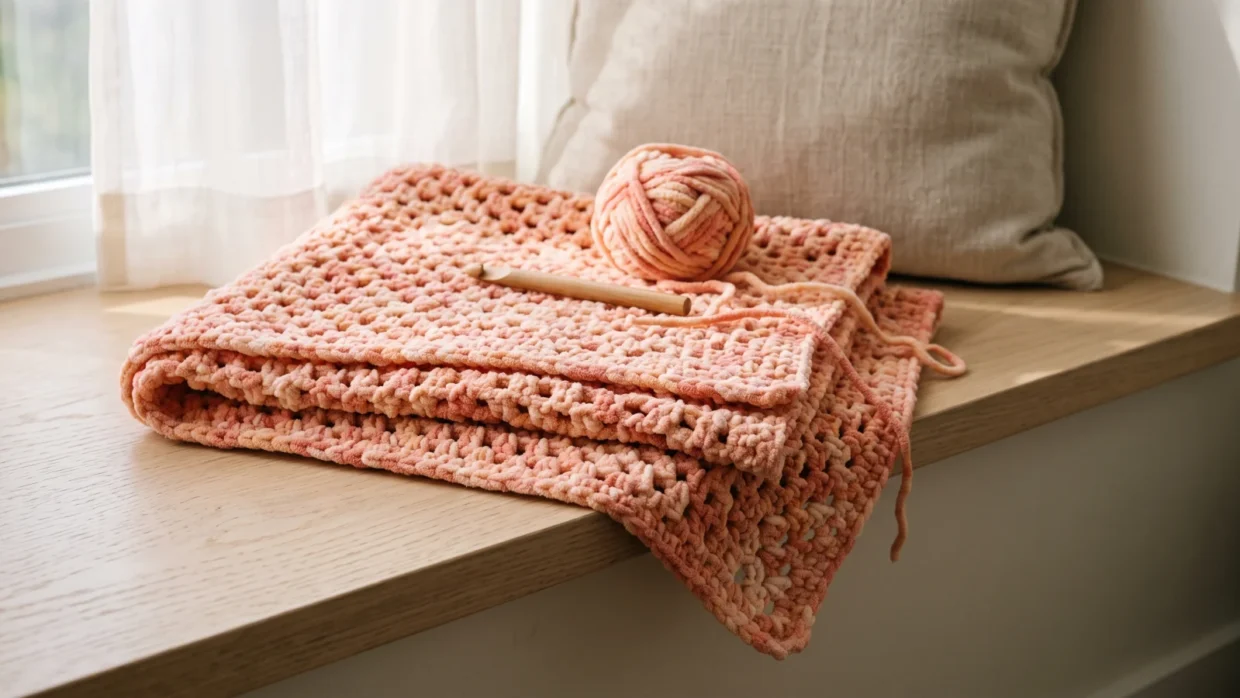
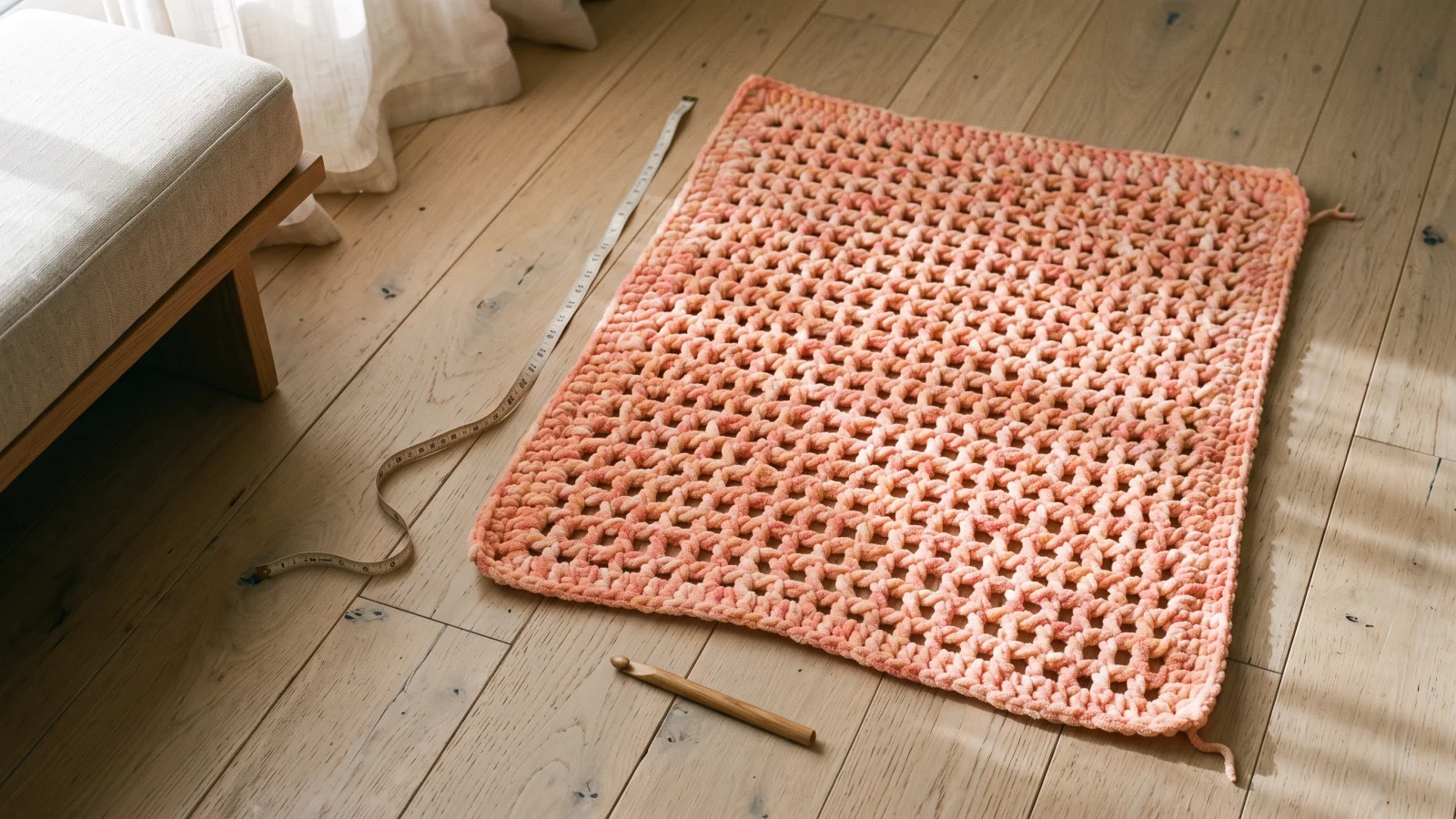
The finished blanket in Peachy, an open single crochet mesh with a single crochet edging, draped over a wooden window seat
Pattern at a Glance
- Skill level
- Beginner
- Yarn weight
- Super bulky (#6)
- Yarn brand
- Bernat Baby Blanket
- Hook size
- 10 mm (US N/15)
- Finished size
- About 34 × 36 in
- Yarn needed
- 2 balls (220 yd each)
- Construction
- One piece, worked flat in rows, with a single crochet edging
- Stitches
- Chain, single crochet, slip stitch
- Gauge
- 5 sc and 6 rows = 4 in
- Pattern type
- Free written pattern
- Project type
- Baby blanket
A simple blanket rarely goes wrong because of the stitches. It goes wrong when the count slips by one and the edges start to lean. This crochet newborn blanket pattern is built to make that hard to do: it uses only chain, single crochet and one slip stitch, every row has the same 59 stitches, and the body is one pair of rows repeated to 35 inches.
Worked in two balls of Bernat Baby Blanket in Peachy with a 10 mm (US N/15) hook, it finishes at about 34 inches wide by 36 inches long (86.5 x 91.5 cm). The fabric is an open mesh of single crochet and chain-1 spaces. That mesh is why it works up quickly, and also why the spaces need your attention. To compare designs before you commit, you can browse more newborn blanket patterns first.
Pattern at a glance
| Detail | What to know |
|---|---|
| Skill level | Beginner |
| Finished size | About 34 in wide x 36 in long (86.5 x 91.5 cm) |
| Yarn | 2 balls Bernat Baby Blanket, 10.5 oz (300 g) and 220 yd (201 m) each, in Peachy (04510) |
| Hook | 10 mm (US N/15), or the size needed to reach gauge |
| Gauge | 5 sc and 6 rows = 4 in (10 cm) |
| Stitches used | Chain, single crochet, slip stitch |
| Stitches per row | 59 on every row |
| Construction | One piece worked flat in rows from a foundation chain, finished with one round of single crochet edging |
Is this really a beginner pattern?
It is labeled beginner, and the construction backs that up. There is no shaping, no seaming, no color changes and nothing harder than a slip stitch. The skills needed are short: a long chain, single crochet into a chain and into a chain-1 space, skipping stitches, turning, and three single crochet in one corner.
The difficulty is in the counting and the seeing. Sixty chains is long enough to lose your place. A plush super bulky yarn also softens the outline of every stitch, so a chain-1 space is harder to find than in a smooth yarn. And the two ends of each row follow slightly different rules, which is where most errors begin. The count checks below target those points. If you want something even more forgiving, here is another easy baby blanket pattern to compare.
Materials
- Yarn: 2 balls of Bernat Baby Blanket, 10.5 oz (300 g) and 220 yd (201 m) per ball, in Peachy (04510). Together that is 440 yd (about 402 m).
- Hook: 10 mm (US N/15), or the size needed to obtain gauge.
- Notions: a yarn needle, scissors, a tape measure, and an optional stitch marker for the edging round.
Bernat Baby Blanket is a super bulky polyester yarn, and that shapes the project. It is soft and plush, covers a lot of ground in few stitches, and polyester is generally an easy-care fiber, which suits something washed often. What it does not give you is crisp stitch definition. In a mesh that is fine, but it is why I would slow down at the spaces.
You can swap yarns, but treat it as a change to the whole project. A different super bulky yarn may give a different gauge, which changes the finished size. A thinner yarn on the same hook gives a looser mesh, and a stiffer one gives less drape. Use 440 yd as your starting figure and compare it with the label before you buy.
Finished size, and whether it suits a newborn
The finished blanket measures approximately 34 inches wide by 36 inches long (86.5 x 91.5 cm). That is close to square, which makes it easy to fold, tuck around a baby or lay over a lap.
Is that a newborn size? I would judge it by the dimensions: at 34 by 36 inches it is a generous blanket, roomy enough to wrap a newborn and large enough that it will not be outgrown quickly. If you want something smaller, the resizing section below shows how, and the baby blanket size guide covers sizes in more detail.
Gauge, and why a swatch helps
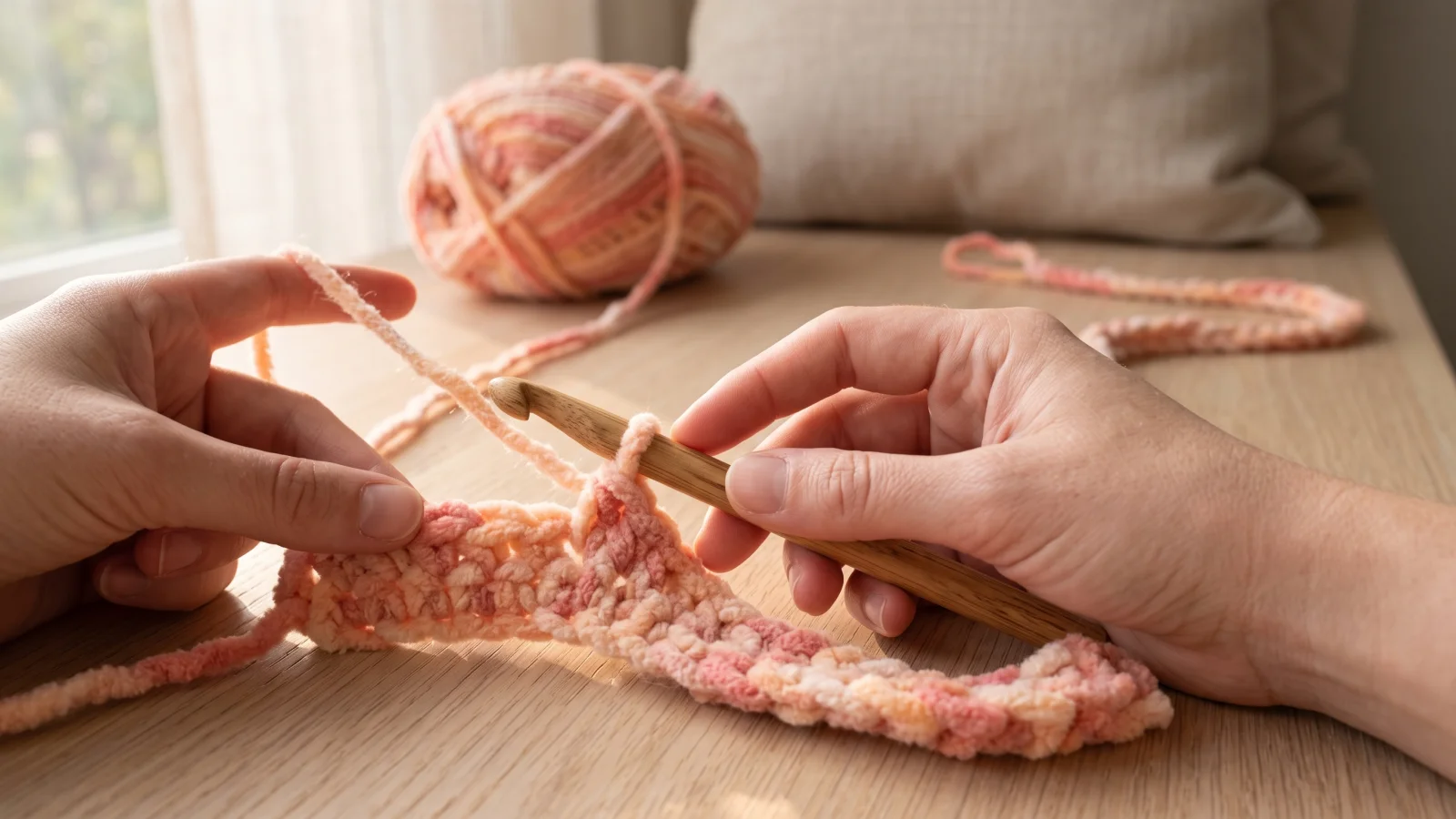
Gauge is 5 sc and 6 rows = 4 in (10 cm). For a blanket, gauge is forgiving: a different gauge will not break the pattern, it mostly changes the finished size. Row gauge matters most for length: at 6 rows per 4 inches, each row adds about two-thirds of an inch.
I would still swatch, because it is the only way to check the mesh before you commit sixty chains and two balls of yarn. Work a small sample in the same pattern and measure the rows across 4 inches. More rows than gauge means a larger hook; fewer means a smaller one. Once the blanket is under way, lay the first few rows flat and measure the width. It should be heading toward 34 inches, a better check than counting stitches against gauge.
How to measure gauge
- Work a swatch at least 6 in (15 cm) wide and 6 in tall, in the blanket pattern, so the edge stitches stay out of the measurement.
- Lay it flat on a table without stretching or pulling it. If you plan to wash the blanket, wash and dry the swatch the same way first.
- Place a ruler across the middle of the swatch and mark 4 in (10 cm) with two pins. Count the single crochet between the pins. Do not count the chain-1 spaces; the gauge counts single crochet only.
- Turn the ruler to run up the swatch, mark 4 in (10 cm) again and count the rows between the pins.
- Compare both counts with the gauge above. If you have more stitches or rows than the gauge, use a larger hook; if you have fewer, use a smaller one, and swatch again.
Abbreviations and terms
- Approx = approximately; Beg = beginning; Ch(s) = chain(s); Pat = pattern; Rep = repeat
- Rnd = round; Sc = single crochet; Sl st = slip stitch; Sp(s) = space(s); St(s) = stitch(es)
All terms are US. Single crochet is the shortest basic stitch; the UK name for it is double crochet. Two more terms matter here.
- Ch-1 space: the opening left when you chain 1 and skip a stitch. Put your hook into the opening under the chain, not into the chain stitch itself.
- Turning chain: the ch 1 at the start of each row. It only brings your hook up to height, so it does not count as a stitch and you do not work into it. Your first single crochet goes into the first single crochet of the row below.
Crochet newborn blanket pattern instructions
Counts include each ch-1 as a stitch, which is how the total of 59 is reached. Every row ends with its count in parentheses so you can compare it with your own work.
Foundation chain
Ch 60. (60 ch)
Keep the chain relaxed, since it becomes the bottom edge and a tight chain pulls it in. Count the chains before Row 1, not counting the loop on your hook. Recounting now is far easier than pulling back later.
Row 1
Row 1: Sc in 2nd ch from hook. *Ch 1, skip next ch, sc in next ch. Rep from * to end of chain. Turn. (59 sts: 30 sc and 29 ch-1 sps)
To skip a chain is to pass over it without working into it. Count the chain nearest the hook as chain 1; your first single crochet goes into chain 2, and the loop on your hook is not counted. After that first single crochet, every repeat uses two chains, one skipped and one worked into, which is why the chain is an even number. At the end you should have 30 single crochet with a chain-1 space between each.
Row 2
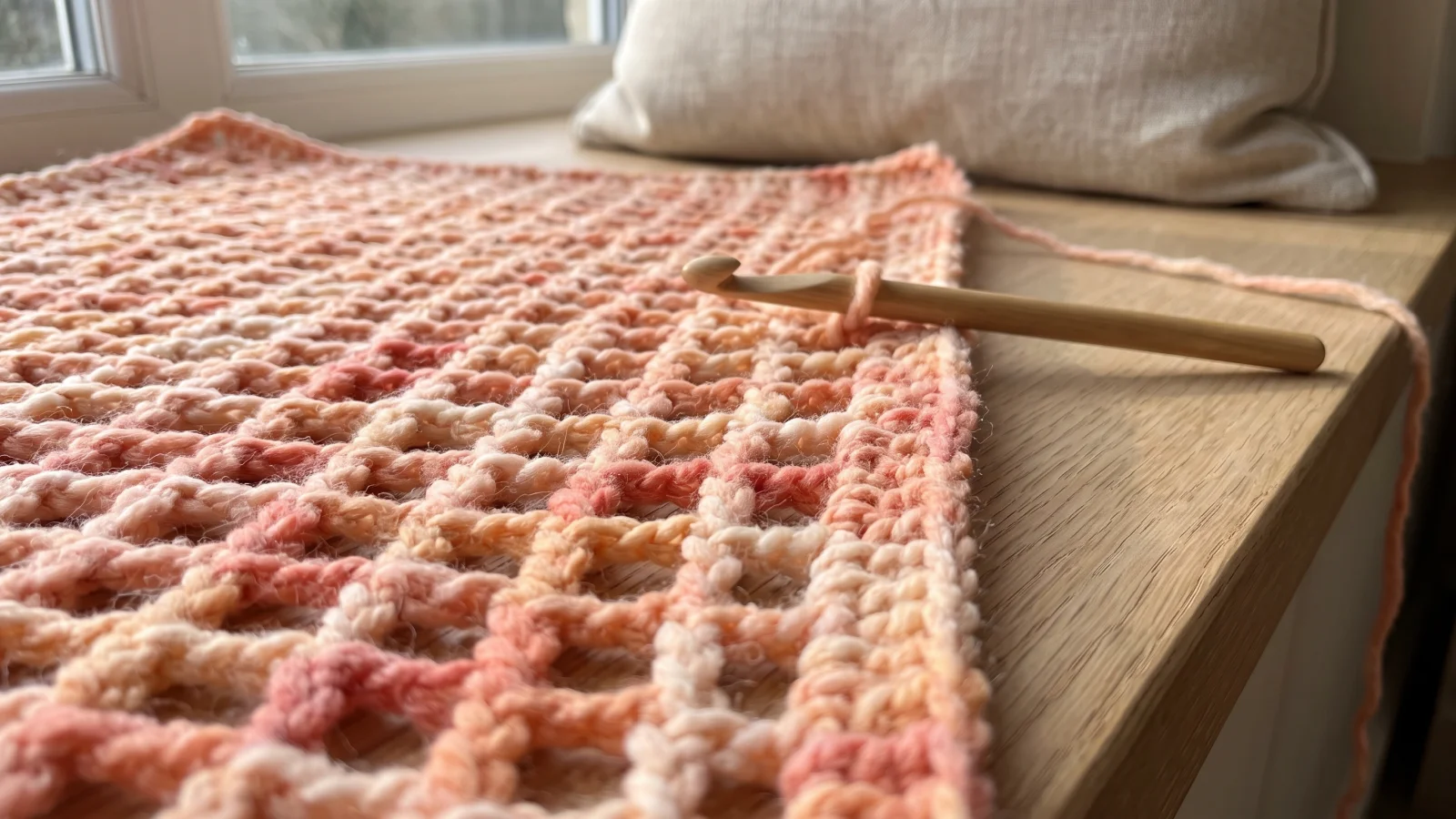
Row 2: Ch 1. Sc in first sc. Sc in next ch-1 sp. *Ch 1, skip next sc, sc in next ch-1 sp. Rep from * to last sc. Sc in last sc. Turn. (59 sts: 31 sc and 28 ch-1 sps)
Your first single crochet goes into the first single crochet of Row 1, and the second goes into the first chain-1 space, so those two stitches sit side by side. After that you alternate: chain 1, skip the single crochet below, work a single crochet into the next space. This offsets the pattern, so spaces land above the single crochet of the row below.
Row 3
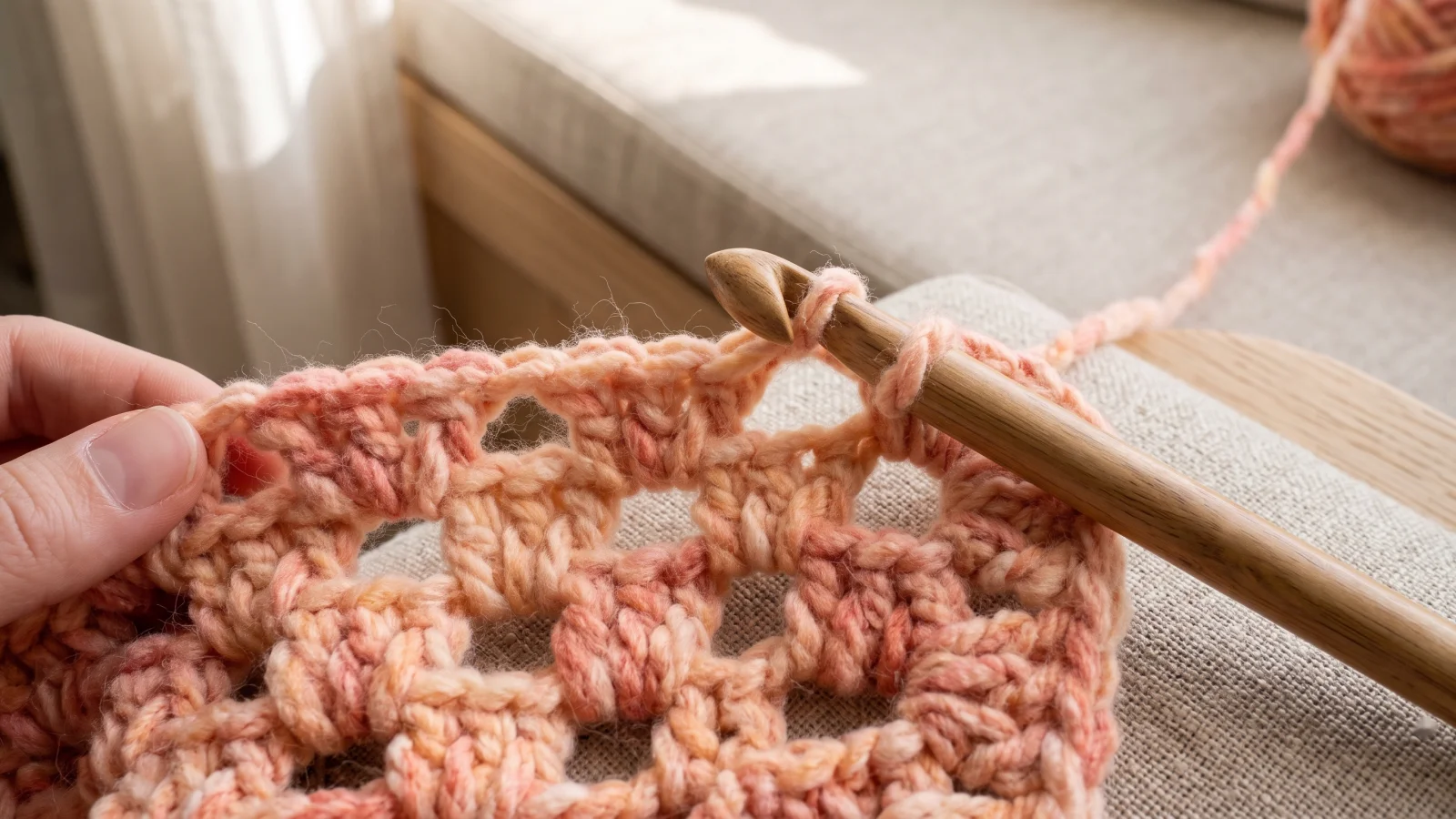
Row 3: Ch 1. Sc in first sc. *Ch 1, skip next sc, sc in next ch-1 sp. Rep from * to last 2 sc. Ch 1, skip next sc, sc in last sc. Turn. (59 sts: 30 sc and 29 ch-1 sps)
Row 3 looks different at the ends. It begins with one single crochet and then a space, and finishes with a space and then one single crochet. The phrase “last 2 sc” means the two side-by-side single crochet at the end of Row 2. Skip the first and work your final single crochet into the second.
Repeat to length
Rep Rows 2 and 3 until the work measures 35 in (89 cm) from the beginning. Do not fasten off. (59 sts on every row)
Measure with the blanket lying flat and relaxed, from the foundation chain edge, without stretching. At the stated row gauge, 35 inches is roughly 52 or 53 rows including Row 1, but trust the tape measure over a tally. Finish a full row before you stop; one extra row adds only about two-thirds of an inch.
Edging
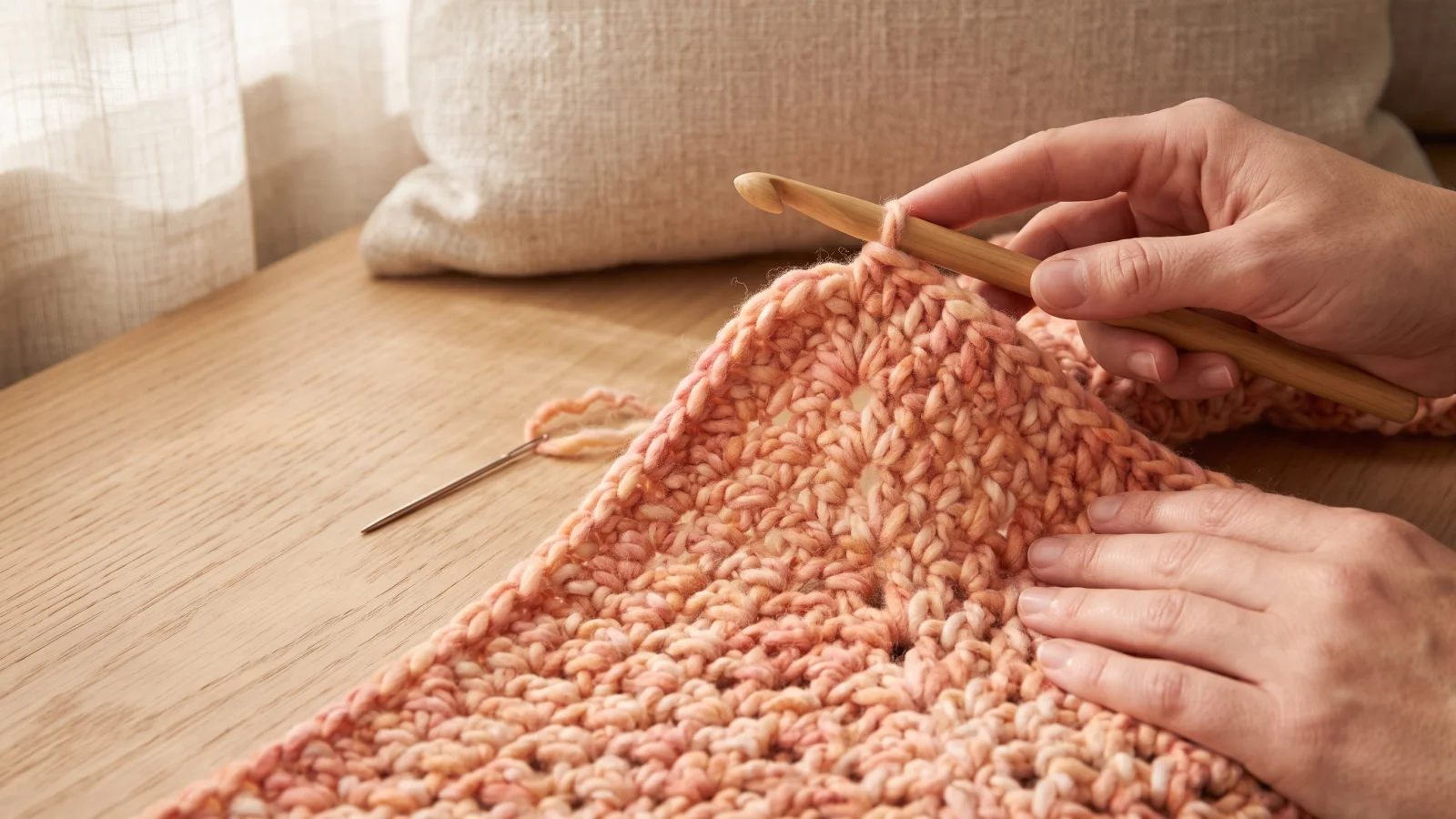
Edging, round 1: Ch 1. Work 1 rnd of sc evenly around outer edge of blanket, working 3 sc in each corner. Join with sl st to first sc. Fasten off. (12 corner sc, plus evenly spaced sc along the sides; the total depends on your row count)
Because you did not fasten off, you carry on with the same yarn from the corner where you finished. As a starting point, work about one single crochet into each row end along the sides and one into each stitch or space along the top and bottom. The three single crochet in each corner let the edging turn flat. The edging adds roughly an inch to the length, which is how 35 inches becomes 36.
How to check your count as you go
| Row | Single crochet | Ch-1 spaces | Total stitches | How the ends look |
|---|---|---|---|---|
| Row 1 | 30 | 29 | 59 | One sc at each end |
| Row 2 | 31 | 28 | 59 | Two sc side by side at each end |
| Row 3 | 30 | 29 | 59 | One sc, then a space, at each end |
Count the total. Every row has 59 stitches. If you count 58 or 60, stop there instead of finding out ten rows later.
Look for the checkerboard. Spaces sit above single crochet, and single crochet sit above spaces. If two spaces stack directly on top of each other, you skipped the wrong stitch in that row.
Watch the edges. The sides should stay straight. If one creeps outward you have probably added a stitch at that end; if it creeps inward, you have missed one.
Finishing and blocking
Weave in the ends with a yarn needle, running each tail through several stitches one way and then back the other.
Blocking is optional here. The plain mesh and single crochet edging usually just need smoothing by hand, and polyester does not hold a blocked shape the way natural fibers do. If you do want to block, check the ball band before using heat or steam, and see how to block a crocheted blanket.
Changing the size
Width. Change the foundation chain, keeping it an even number. Each repeat uses two chains, so the stitches per row equal the chain minus 1. Every extra two chains adds one single crochet and one chain-1 space to each row. Sixty chains gives about 34 inches, so each pair you add or remove changes the width by roughly 1.1 inches. Confirm that against your own swatch.
Length. Stop at a different measurement. Each row adds about two-thirds of an inch at the stated gauge, so every extra 4 inches is 6 more rows.
Yarn. Yarn use grows with area, so a larger blanket needs more than two balls. Buy the extra ball before you start.
Colorway and yarn choices
Peachy is a soft variegated blend of peach, pink and cream. The pattern is identical in any colorway of the same yarn. For a gender-neutral blanket, a pale solid or soft neutral keeps the mesh easy to see. A variegated yarn like Peachy makes the spaces harder to spot, so use the checkerboard check more often.
Troubleshooting
- The blanket is getting wider or narrower. Almost always an end stitch: a missed last single crochet, or one worked into the turning chain. Count back to the first row without 59 stitches and pull out to the row before it.
- The count is off and you cannot see where. Read the checkerboard from the bottom up. The row where two spaces stack, or two single crochet sit together mid-row, is the one to redo.
- There is a gap or bulge at the start of a row. A very loose turning chain leaves a gap, and working into it makes a bulge. Keep it snug and put the first single crochet into the first single crochet.
- The edges are wavy or curling. Waves usually mean too many stitches, and curling inward usually means too tight. In the edging round, ruffling means too many single crochet and pulling in means too few.
- The finished size is not 34 by 36 inches. Check gauge, then hook size, then any yarn substitution, and measure the blanket itself.
- Tension changes between sessions. Before restarting, compare the last two rows with the rows below, and use the same hook with a relaxed grip.
- You are running short of yarn. With the stated yarn, two balls cover the blanket and edging. With a different yarn, check its yardage against 440 yd first.
Care, and using it with a baby
Follow the ball band for washing and drying, since it is specific to the yarn. After the first wash, check that the woven-in ends are still secure.
This design has no ties, cords, buttons or attached decorations. As with any open-textured blanket, keep an eye on small fingers and toes around the spaces, especially once a baby is moving. I would not describe this blanket, or any crochet blanket, as suitable for unsupervised sleep. For more on using crochet blankets around babies, see safety guidance for crochet baby blankets.
Frequently asked questions
How much yarn does this blanket need?
Two 220 yd balls of Bernat Baby Blanket, 440 yd in total, cover the blanket and edging. A different yarn needs a yardage check before you buy.
Can I use it in a crib or for sleep?
I would not suggest it for unsupervised sleep. The safety article linked above covers using crochet blankets around babies.
If you remember one thing, make it the row ends: check them every few rows and this blanket nearly works itself. For a different design next, try a different free newborn blanket pattern.

Last updated . Found something out of date? Let us know.