 Accessories
 Baby & Kids
 Blankets & Afghans
 Clothing
How to Crochet a Blanket With Chunky Yarn
Chunky yarn changes more than how fast a blanket grows. If you want to know how to crochet a blanket with chunky yarn, the decisions that matter are hook size, stitch choice, stitch count, and yardage, because thick yarn shifts gauge, drape, weight, and how much yarn you need.
 Nicole Sinclair
Published · 10 min read
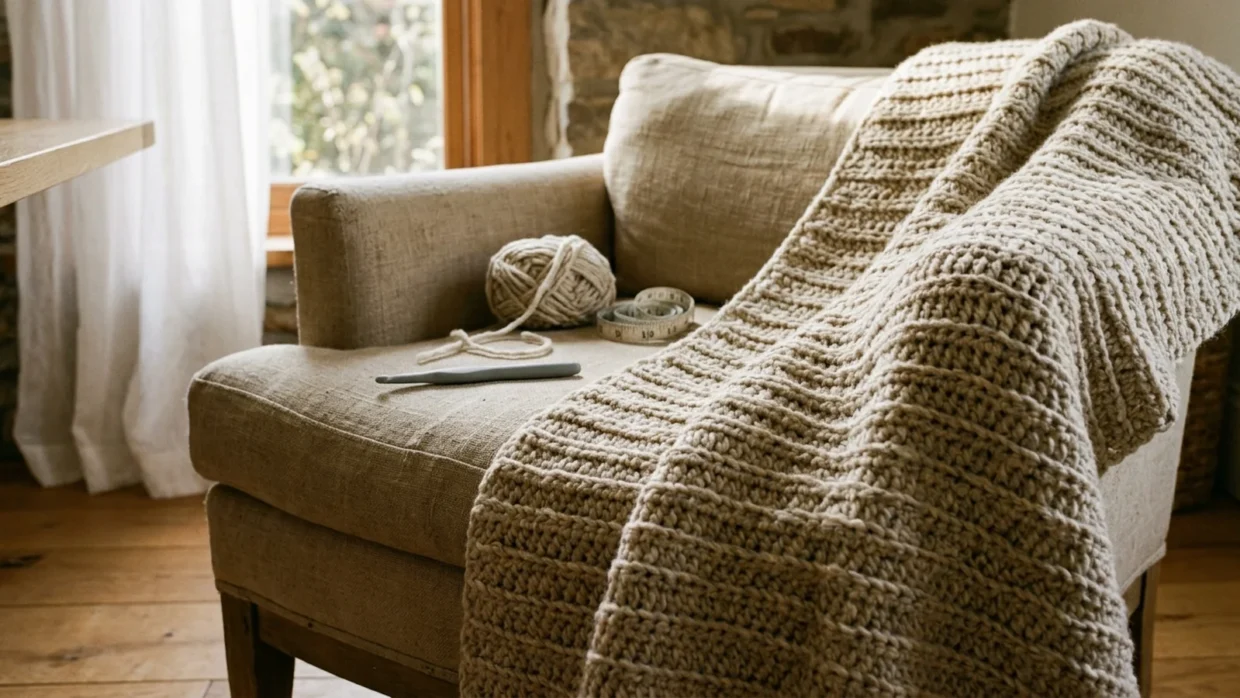
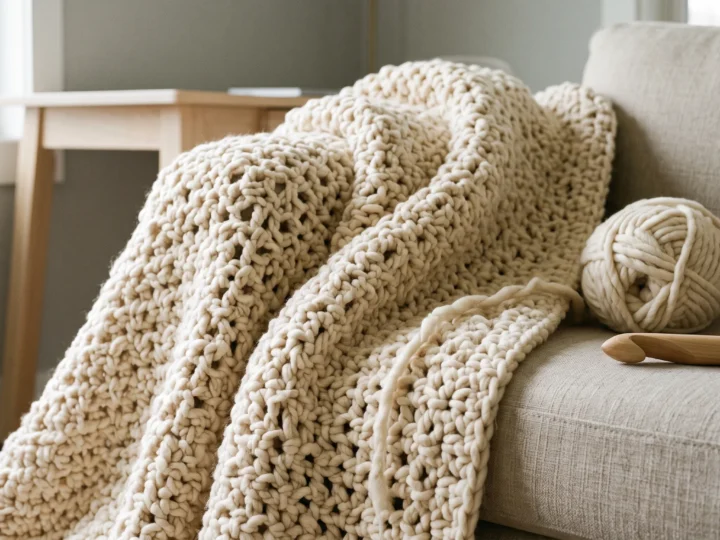
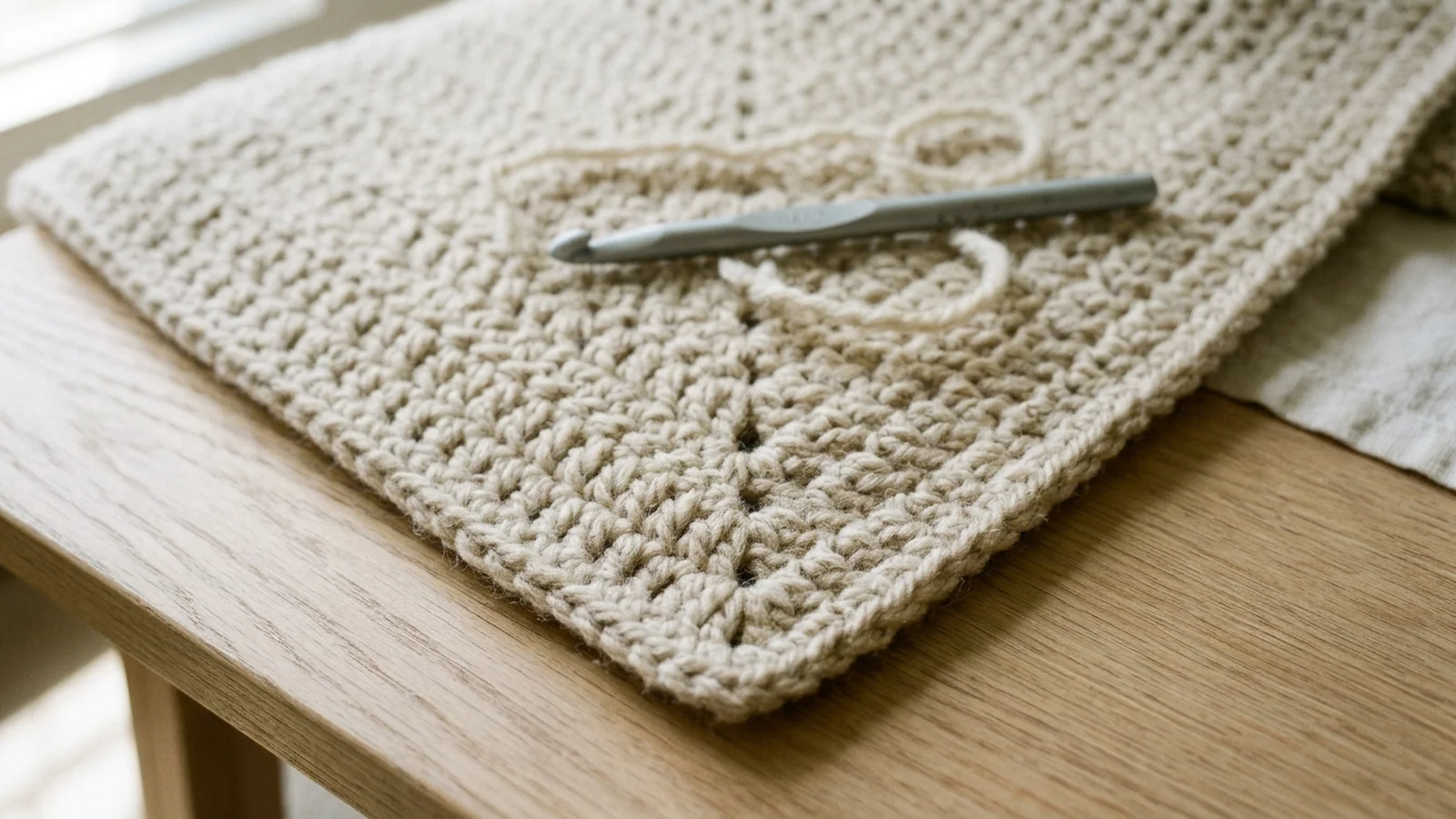
A finished chunky half double crochet blanket in oatmeal bulky yarn draped over a linen armchair
Pattern at a Glance
- Skill level
- Beginner
- Yarn weight
- Bulky (#5)
- Hook size
- 8 mm (L-11)
- Finished size
- 40 × 50 in (example)
- Yarn needed
- Calculate from your swatch
- Construction
- Worked flat in rows
- Stitches
- Chain, half double crochet
- Gauge
- 8 hdc and 6 rows = 4 in (example)
- Pattern type
- Tutorial
- Project type
- Blanket
Thick yarn is forgiving in some ways and unforgiving in others. The stitches are easy to see and the rows grow quickly, but a small change in hook size or tension can turn a plush blanket into a stiff board or a loose net. This guide covers how to crochet a blanket with chunky yarn in the order the decisions actually come up: gauge first, then stitch, then stitch count, then yardage and fiber.
I use one worked example throughout: half double crochet in bulky yarn with an 8 mm hook. Its numbers are illustrative, so swap in the measurements from your own swatch.
What Counts as Chunky or Bulky Yarn
“Chunky” is a shop word, not a standard. Some brands use it for bulky yarn, some for yarns that sit closer to super bulky, and two skeins with the same label can behave differently. The Craft Yarn Council’s numbered system is more reliable, although it still describes ranges rather than guarantees.
| Yarn label | Typical crochet gauge | Commonly published hook range |
|---|---|---|
| Bulky (#5) | 8–11 sts per 4 in | 6.5–9 mm |
| Super bulky (#6) | 7–9 sts per 4 in | 9 mm and larger |
Your ball band lists its own gauge and suggested hook, and I would trust that over the word on the front of the label. Do not treat a chunky yarn and a bulky yarn as interchangeable until you have compared the weight symbol, yards per ball, and fiber content. The published ranges are usually given for single crochet, so taller stitches can measure differently, and even within one category the spread is wide enough to change how many stitches a blanket needs.
Choose a Hook and Check Gauge Before You Chain
Start with the hook range on the label, then let a swatch make the decision. I would begin in the middle of the range rather than at either end, because a blanket usually benefits from fabric that bends. Common hooks for this yarn range are 6.5 mm (K-10.5), 8 mm (L-11), 9 mm (M/N-13), and 10 mm (N-15). Go by millimeters, since letters vary between brands.
- Chain 22, then work half double crochet into the third chain from the hook and in each chain across (20 sts). Keep working rows of 20 stitches for about 12 rows.
- Wash and dry the swatch the way you plan to care for the blanket, since some fibers relax or fuzz.
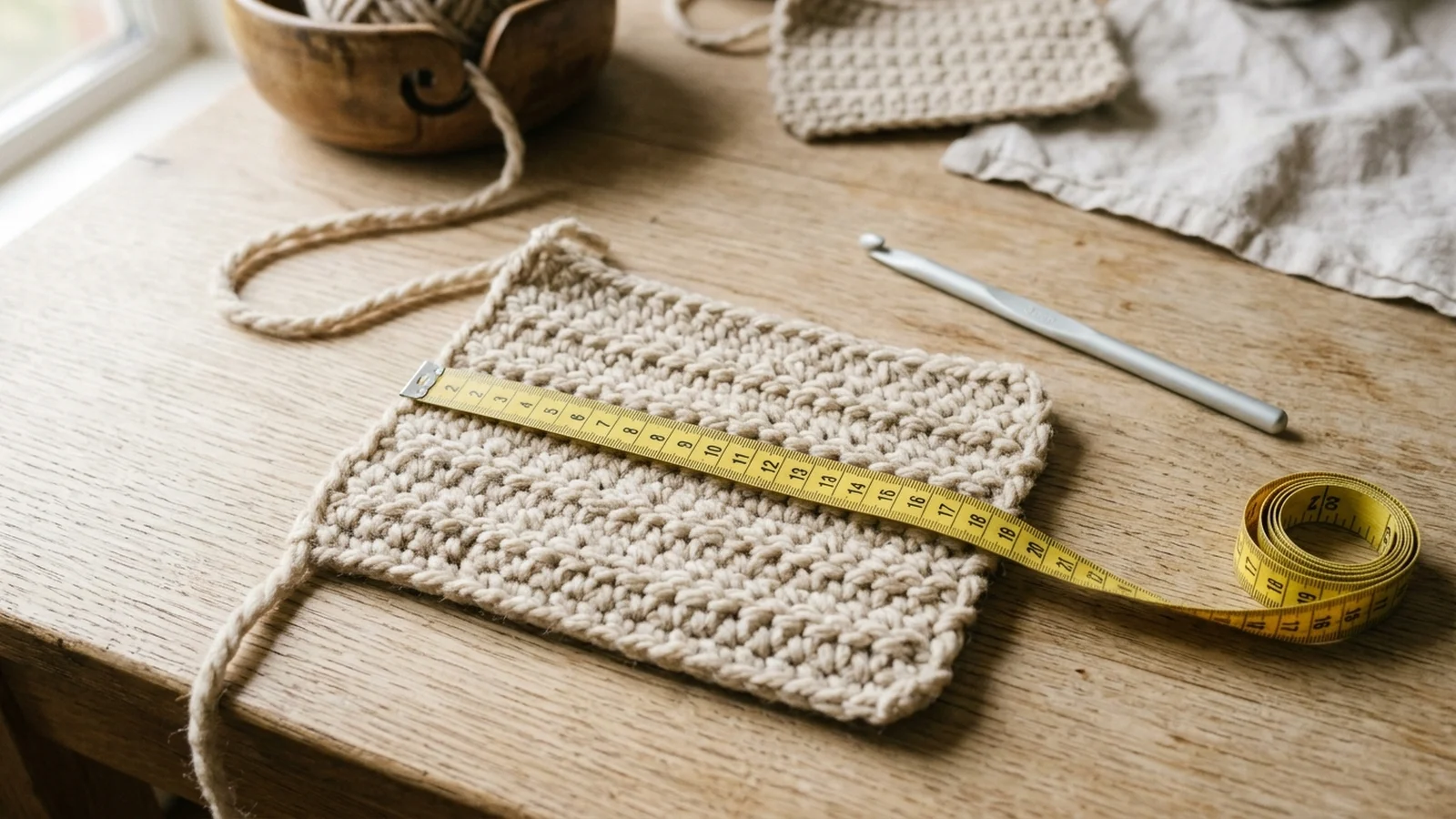
- Measure over 4 in in the center of the swatch, away from the edges, and count the stitches and rows.
- Bend the swatch. If it stands up like a placemat, go up a hook size. If you can see daylight between stitches or the loops look sloppy, go down.
Gauge is not critical for a blanket the way it is for a sweater. A different gauge mainly changes the finished dimensions and drape, not fit. But gauge is what converts your target width into a stitch count, so I would not skip it. In the example, 8 half double crochet stitches and 6 rows measure 4 in, which works out to 2 stitches and 1.5 rows per inch.
How Chunky Yarn Changes Each Stitch
Thick yarn amplifies whatever the stitch is already doing.
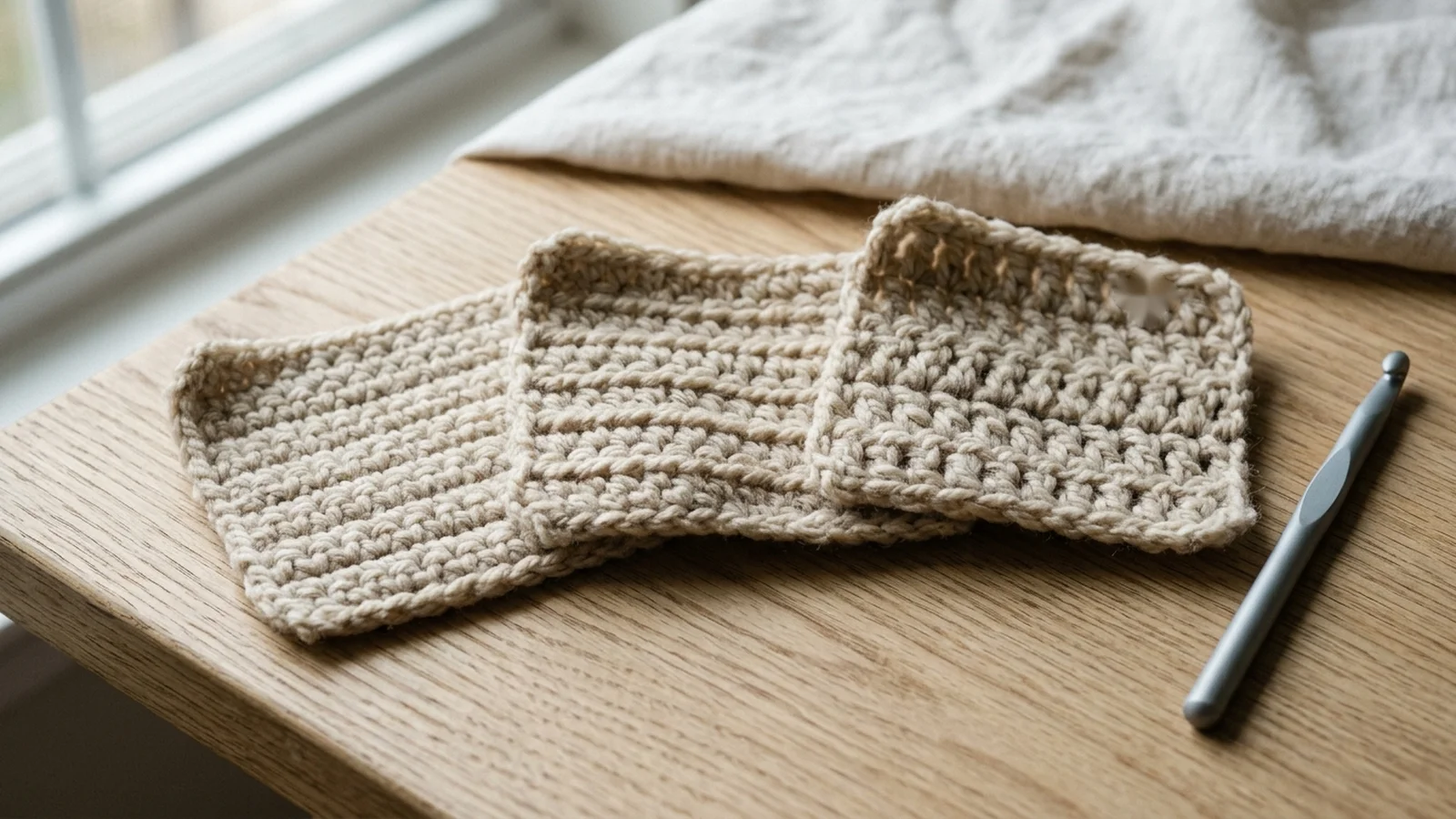
- Single crochet: dense, thick, and heavy. Rows are short, so height grows slowly, and with too small a hook the fabric can feel stiff. Going up a hook size helps.
- Half double crochet: a good middle ground. It is dense enough to hold its shape and flexible enough to drape, and it leaves a horizontal ridge that shows well in thick yarn. That balance is why I chose it for the example.
- Double crochet: taller stitches build height quickly and drape more, but with a large hook the loops can open up and leave gaps at the tops of stitches.
- Textured or open stitches: puffs, bobbles, clusters, and mesh use extra yarn. In bulky yarn a bobble becomes very large and heavy, and open mesh can sag under its own weight.
Choose the stitch after swatching, not before. The same yarn and hook can produce a stiff single crochet fabric and a floppy double crochet one, and a textured stitch may need a hook one size different from what the label suggests.
Turn Blanket Size Into a Stitch Count
Multiply the width you want by your stitches per inch to get the stitch count, and multiply the length by your rows per inch to get the row count. Then add the foundation chain allowance for your stitch. For stitch patterns with a repeat, chain a multiple of the repeat plus the pattern’s edge allowance.
| Stitch | Foundation chain | First stitch goes in |
|---|---|---|
| Single crochet | Stitches + 1 | 2nd ch from hook |
| Half double crochet | Stitches + 2 | 3rd ch from hook |
| Double crochet | Stitches + 2 | 4th ch from hook (the skipped chains count as the first dc) |
Thicker yarn reduces the count dramatically. At the example gauge, a blanket 40 in wide needs only 80 stitches, while the same width in worsted yarn at 3.5 stitches per inch would need 140.
| Size | Approx. dimensions | Stitches | Foundation chain | Rows |
|---|---|---|---|---|
| Baby | 30 × 36 in | 60 | 62 | 54 |
| Lap | 36 × 48 in | 72 | 74 | 72 |
| Throw (worked example) | 40 × 50 in | 80 | 82 | 75 |
| Large throw | 50 × 60 in | 100 | 102 | 90 |
These are common blanket sizes rather than fixed standards, and the counts assume the example gauge, so recalculate with your own. The baby size makes a simple chunky baby blanket with no shaping. For that use I would choose a soft, machine-washable yarn and a stitch without large open holes that small fingers could catch.
How to Crochet a Blanket With Chunky Yarn: A Worked Example
For the 40 × 50 in size you need bulky (#5) yarn, an 8 mm (L-11) hook, a large-eyed yarn needle, and scissors. I have not named a brand because yardage depends on the yarn you choose, and I would rather you calculate it than guess.
Abbreviations (US terms): ch = chain, st(s) = stitch(es), sc = single crochet, hdc = half double crochet, dc = double crochet. If you follow UK patterns, US sc equals UK double crochet, US hdc equals UK half treble, and US dc equals UK treble.
- Foundation: Ch 82. (82 chs)
- Row 1: Hdc in the 3rd ch from the hook and in each ch across. The 2 skipped chains do not count as stitches. Turn. (80 sts)
- Row 2: Ch 2 (does not count as a st), hdc in each st across. Turn. (80 sts)
- Rows 3–75: Repeat Row 2. (80 sts)
- Finish: Fasten off, leaving a tail about 12 in long, and weave in all ends.
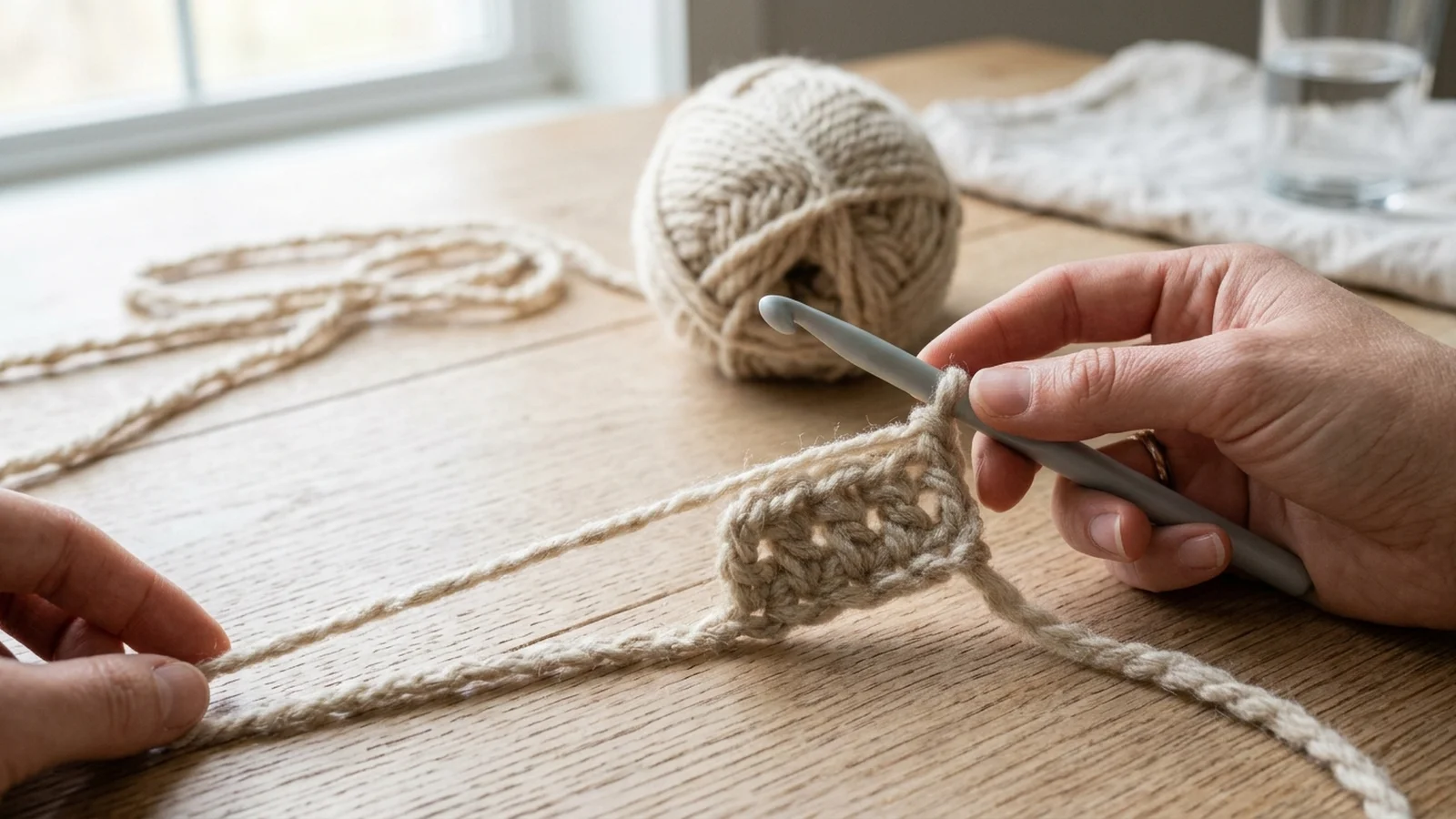
Work the last hdc of each row into the top of the previous row’s final stitch, not into the turning chain, because the ch 2 does not count as a stitch. If the edge drifts inward, a missing end stitch is the usual reason. Count after Row 1 and every ten rows or so. By Row 75 the blanket should measure about 40 in wide and 50 in long.
Yarn, Fiber, and Yardage
Buy by yardage, not by ball count. Balls of bulky yarn vary a lot in length, so a substitution that looks equal on the shelf can leave you short. To estimate how much you need, measure or weigh the yarn your swatch used, then scale up by area: divide the blanket’s area in square inches by the swatch’s area and multiply by the swatch’s yardage.
As an example only, suppose a 4 × 4 in swatch (16 square inches) uses 8 yd. A 40 × 50 in blanket is 2,000 square inches, which is 125 swatches, so about 1,000 yd. Add roughly 10 percent for tails, a border, and swatch variation, and you land at 1,100 yd. For a fuller treatment, see how much yarn for a crochet blanket.
Fiber changes how the same gauge feels. Wool and wool blends tend to be springy and warm. Acrylic is usually lighter and easier to care for. Cotton is dense, heavy, and has little elasticity, so I would think twice before choosing it for a large chunky throw. Chenille-style and tube yarns can hide stitch definition and snag, which makes swatching even more important.
Weight is easy to estimate once you know yardage. If a yarn runs 100 yd per 100 g ball, 1,100 yd weighs about 1,100 g, or roughly 2.4 lb. A yarn with fewer yards per gram weighs more, and that weight sits on your lap while you work.
Is a Chunky Blanket Faster?
Often, but I would not promise it. Fewer stitches and rows do reduce the work. At the example gauge the blanket needs about 6,000 stitches (80 × 75), while a worsted version at 3.5 stitches and 2.5 rows per inch would need roughly 17,500 for the same size. But each chunky stitch takes longer to make, and large hooks and heavy yarn can tire your hands. For more ways to speed up a blanket, see fast crochet blanket methods.
Material Handling Versus Crochet Skill
The example uses only chain and half double crochet, so the skill level is beginner. The difficulty comes from the material. A large hook needs a different grip, the growing blanket gets heavy on your lap, and thick plied yarn can split if you pull the hook through too quickly. Thick tails are awkward to weave in, so I would untwist the plies and weave each half in a different direction. The upside is that mistakes are easy to see, so count early and often.
Customize: Stripes, Borders, and Density
- Stripes: at the example gauge, 6 rows measure about 4 in, so stripes in multiples of 6 rows give predictable widths. Carrying yarn up the edge adds bulk, so I would cut and weave in the ends, saving carrying for very narrow stripes.
- Borders: start with one sc per row end along the sides and one sc per stitch across the top and bottom, with 3 sc in each corner stitch. If the edge pulls in, add a stitch here and there. If it ruffles, skip a row end occasionally. A border adds noticeable weight and yarn, so include it in your yardage.
- Density: for a denser fabric, drop a hook size or move from double crochet to half double crochet. For more drape, go up a hook size. Change one variable at a time and re-swatch.
Converting a Regular Blanket Pattern to Chunky Yarn
Many blanket yarn patterns are written for worsted weight, and they can be converted, but the counts change and you have to do the math. Multiply the pattern’s stitch count by your new stitches per inch divided by the old. For example, a worsted pattern with 126 stitches at 3.5 per inch becomes 126 × 2 ÷ 3.5 = 72 stitches at 2 per inch. Do the same for rows: 100 rows at 2.5 per inch becomes 60 rows at 1.5 per inch.
Then adjust for the stitch pattern’s repeat, and swatch the actual stitch pattern because it may gauge differently from half double crochet. Detailed stitch patterns and colorwork designed for finer yarn can lose definition when enlarged. Motif blankets scale differently: each motif grows, so fewer motifs make the same size. Recalculate yardage after any conversion.
Troubleshooting Chunky Blankets
- Stiff fabric: the hook is probably too small for the stitch, your tension is tight, or the fiber is dense. Go up a hook size, or switch to a taller stitch such as hdc or dc, and re-swatch.
- Oversized loops: the hook is too large or your loops are loose. Go down a hook size, use a shorter stitch, and pull each loop up only as tall as the stitch needs.
- Unexpected weight: weight comes from yardage and fiber together. Weigh your swatch and compare it with the ball’s grams per yard, remembering that dense stitches use more yarn. A lighter fiber or airier stitch can reduce the weight.
- Running short after substitution: the new yarn may have fewer yards per ball. Recalculate from your swatch, buy from the same dye lot, and if you are still short, plan a contrasting border or stripes in a second yarn.
Care for Chunky Blankets
Care depends on the fiber, so follow the ball band and wash your swatch first. Thick blankets hold a lot of water, so they can be much heavier when wet and may exceed what a home washer can handle. Check your machine’s capacity, and where the label allows, dry the blanket flat so the stitches do not stretch under their own weight.
Frequently Asked Questions
What hook size works with chunky yarn?
Start with the range on the label, commonly 6.5–9 mm for bulky yarn and 9 mm or larger for super bulky, then swatch. Go up if the fabric is stiff and down if it looks loose.
Is chunky yarn good for blankets?
It can be, if you want a substantial fabric. Bulky yarn gives quick coverage and clear stitches. The trade-offs are heavier weight, a less breathable fabric, and often more yarn by weight than a thinner yarn would need.
Can a regular blanket pattern be converted to chunky yarn?
Yes, by swatching and scaling the stitch and row counts as shown above. Simple stitch patterns convert easily. Patterns with detailed motifs or repeats need more adjustment.

Last updated . Found something out of date? Let us know.