 Accessories
 Baby & Kids
 Blankets & Afghans
 Clothing
Crochet Shell Stitch Blanket Pattern
A crochet shell stitch blanket gets its texture from one repeat done consistently across every row: fans of five double crochets alternating with single crochets that shift position each time you turn your work.
 Nicole Sinclair
Published · Updated · 11 min read
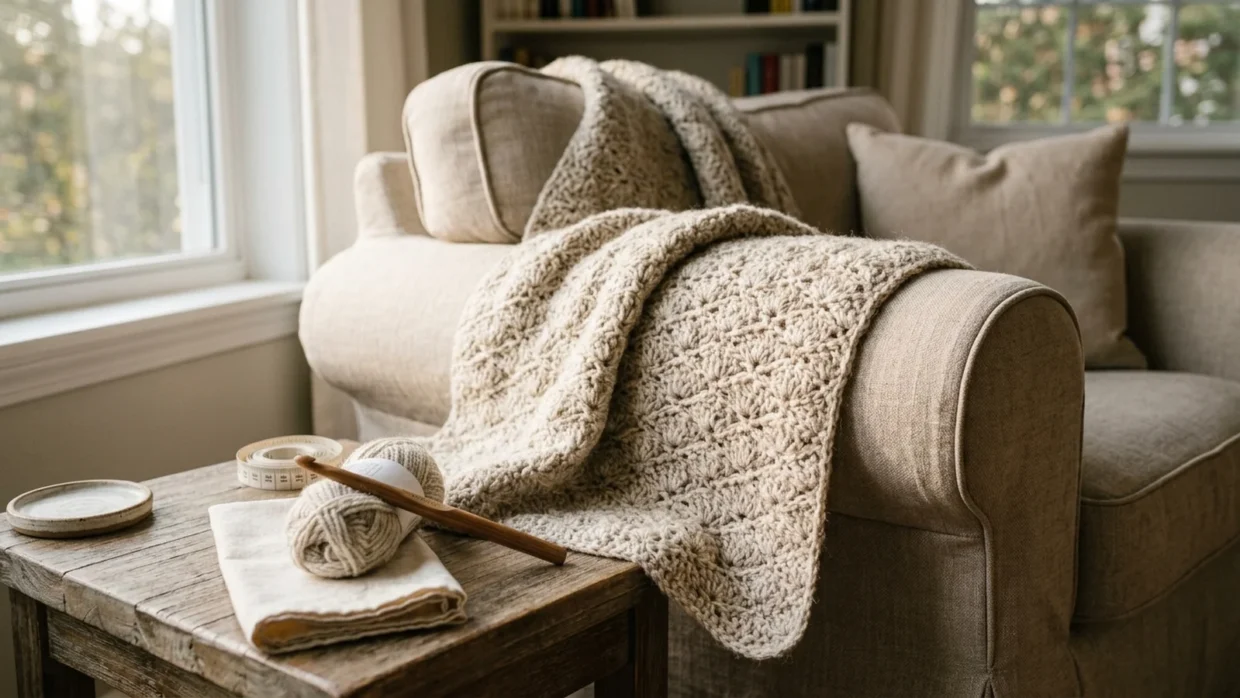
The finished shell stitch throw blanket in a heathered oatmeal worsted yarn, draped over a chair arm to show the alternating shell texture
Pattern at a Glance
- Skill level
- Intermediate
- Yarn weight
- Worsted (#4)
- Hook size
- 5.5 mm (US I-9)
- Estimated time
- About 12–16 hours of hooking (throw size), plus blocking time
- Finished size
- About 48 x 60 in (throw size, before border)
- Yarn needed
- About 2,200 yd (throw size)
- Construction
- Worked flat in rows, side to side, in one piece; finished with a single crochet border
- Stitches
- Chain, single crochet, double crochet (worked as a 5-dc shell and 3-dc half-shell)
- Gauge
- 1 repeat (6 sts) = about 3 in; 4 rows = about 2.5 in, in pattern, after blocking
- Pattern type
- Written row-by-row pattern
- Project type
- Blanket / Throw
A crochet shell stitch blanket earns its texture from a simple trade-off, repeated across every row: fans of five double crochets alternating with single crochets, shifting position each time you turn your work. That shift is what gives shell stitch its layered, almost scalloped look instead of the flatter texture you’d get from straight rows of double crochet. This pattern walks through the exact repeat I use, with stitch counts you can check row by row, sizing for a baby blanket through a full-size throw, and the specific spots where this stitch tends to go sideways if you’re not watching for them.
The Exact Shell Stitch Used Here
There’s more than one construction that goes by “shell stitch,” and mixing two of them in the same project is one of the fastest ways to lose track of your stitch count. The version in this pattern is a 5-dc shell that alternates position every row: shells sit over the single crochets from the row below, and single crochets sit into the center stitch of the shells from the row below. At the two edges, a half-shell — 3 double crochets instead of 5 — keeps the sides from scalloping outward the way a full shell would. Once that shift clicks, the fabric more or less builds itself; the tricky part is almost always the first two or three rows, before your eye adjusts to spotting a shell’s center stitch.
Skill Level: Simple Stitches, More Counting Than You’d Expect
Every stitch in this pattern — chain, single crochet, and double crochet — is a stitch a first-month crocheter already knows. What pushes it into intermediate territory is the counting, not the stitches themselves. Because shells and single crochets trade places every row, it’s easy to lose your spot if you’re working from memory instead of checking your stitch groups as you go. If you’ve finished at least one project where you had to track a stitch count across a full row — a granny-square blanket doesn’t really count for this, since each square resets — you’re ready for this one.
Materials
- Worsted weight (#4) yarn — an acrylic or acrylic-blend works well and keeps the shells crisp without adding much weight; see the yarn amounts in the sizing table below
- 5.5 mm (US I-9) crochet hook — sized up slightly from the typical worsted-weight hook so the shells sit open rather than tight and cupped
- Yarn needle, for weaving in ends
- Removable stitch markers — genuinely useful here, to flag the center stitch of a shell while you’re still learning to spot it at a glance
- Measuring tape or ruler
I’m giving yarn weight and hook size as a category rather than a single specific product, since the shell fabric is fairly forgiving of yarn choice as long as you stay in the worsted range. A fuzzy or heavily textured yarn will hide the shell shape almost entirely, so a smoother worsted shows this particular stitch pattern best.
Gauge
One repeat — a shell plus its neighboring single crochet, 6 stitches total — measures about 3 in wide, and 4 rows measure about 2.5 in tall, worked in pattern and measured after blocking. Gauge isn’t critical for a blanket the way it is for a garment, but it does determine your finished size, so swatch a small piece first (a chain of 26 gets you about 4 repeats) and compare it to these numbers before committing to a foundation chain for a specific size.
Sizes You Can Make
The sizes below use the gauge above. Because shell stitch fabric relaxes noticeably once it’s blocked, expect your pre-blocking measurements to run a bit smaller than the finished numbers here.
| Size | Shells Across | Foundation Chain | Finished Width | Finished Length | Yarn Needed (approx.) |
|---|---|---|---|---|---|
| Baby | 8 | 50 | About 24 in | About 30 in | About 550 yd |
| Throw (main pattern) | 16 | 98 | About 48 in | About 60 in | About 2,200 yd |
| Adult / Full | 20 | 122 | About 60 in | About 70 in | About 3,200 yd |
These widths and lengths are for the shell fabric alone, before the border. The border in this pattern adds roughly 1 in to each side.
Stitches and Abbreviations
- ch — chain
- sc — single crochet
- dc — double crochet
- sk — skip
- st(s) — stitch(es)
- rep — repeat
- RS / WS — right side / wrong side
Two stitch combinations get their own name in this pattern:
- Shell — 5 dc worked into the same stitch or space
- Half-shell — 3 dc worked into the same stitch or space, used only at the two edges of wrong-side rows
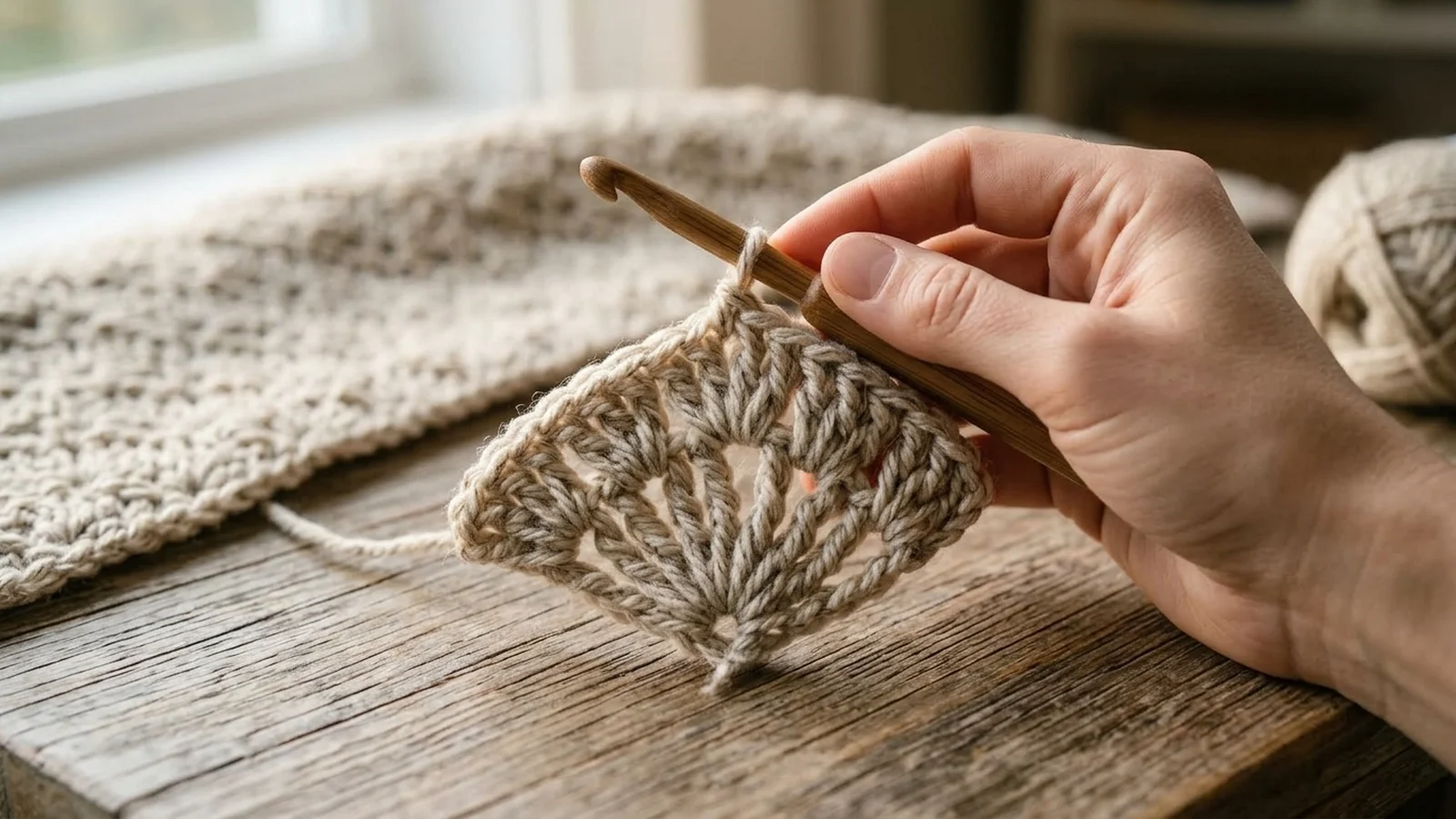
A shell only looks complicated in a photo. In your hands, it’s five double crochets, one after another, without moving your hook to a new stitch in between — the same motion you’d use for five separate double crochets, just aimed at one spot.
Shell Stitch Blanket Pattern Instructions
Instructions below are written for the Throw size (16 shells across). For Baby or Adult/Full, substitute the foundation chain and shell count from the sizing table above, then follow the same row logic — the repeat count changes, the construction doesn’t.
Foundation Chain
Ch 98.
Row 1 (RS)
Sc in 2nd ch from hook. *Sk next 2 ch, 5 dc in next ch (shell made), sk next 2 ch, sc in next ch. Repeat from * 15 more times (16 shells total). Turn. (97 sts)
Row 2 (WS)
Ch 3 (counts as first dc for the rest of the pattern), 2 dc in same st as ch-3 (half-shell made). *Sk next 2 dc, sc in next dc (this is the center dc of the next shell), sk next 2 dc, 5 dc in next st (shell made). Repeat from * 14 more times (15 shells total). Sk next 2 dc, sc in next dc (center of the last shell), sk next 2 dc, 3 dc in last st (half-shell made). Turn. (97 sts)
Continuing the Pattern
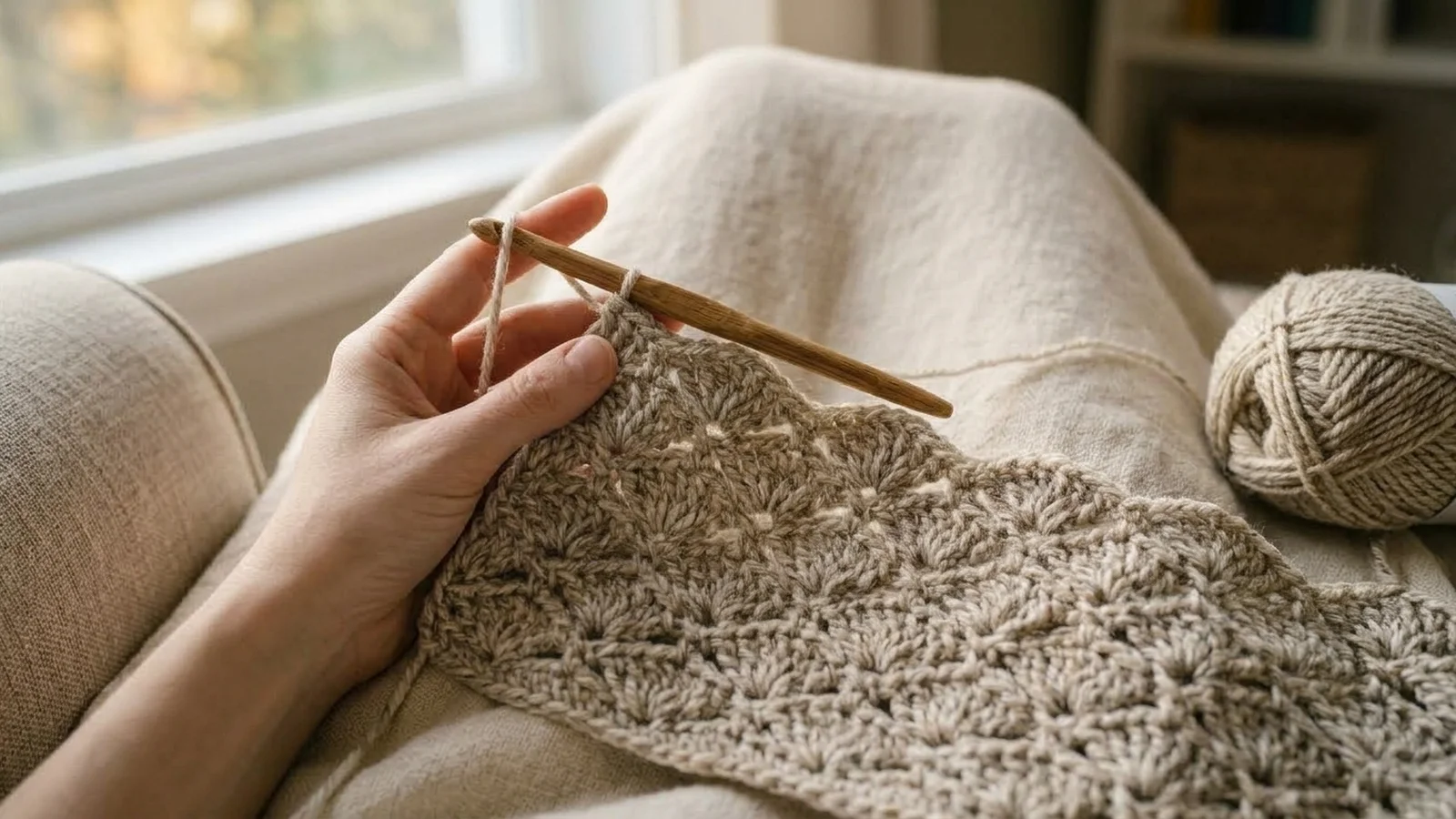
Repeat Rows 1 and 2. Every row should keep the same 97-stitch count — if a row comes up short or long, the mismatch usually traces back to a shell that picked up an extra or missing dc, or a skip that landed on the wrong stitch (more on both in the troubleshooting section below). For the Throw size, work until the piece measures about 60 in from the foundation chain, which is roughly 96 rows. End after a Row 2 for shell edges at the top and bottom, or work one more Row 1 (97 rows total) if you’d rather finish on single crochet edges that match the foundation chain.
Border
Round 1 (RS): Join yarn in any corner if needed. Ch 1, sc evenly around the entire outer edge — an sc in each stitch across the foundation chain and final row, and roughly an sc in each row-end along the two side edges, adjusting every few rows so the edge lies flat rather than cupping or rippling. Work 3 sc into each of the 4 corner stitches. Join with a sl st to the first sc.
Round 2 (RS): Ch 1, sc in each st around, working 3 sc in each corner st again. Join with a sl st to the first sc. Fasten off.
Finishing
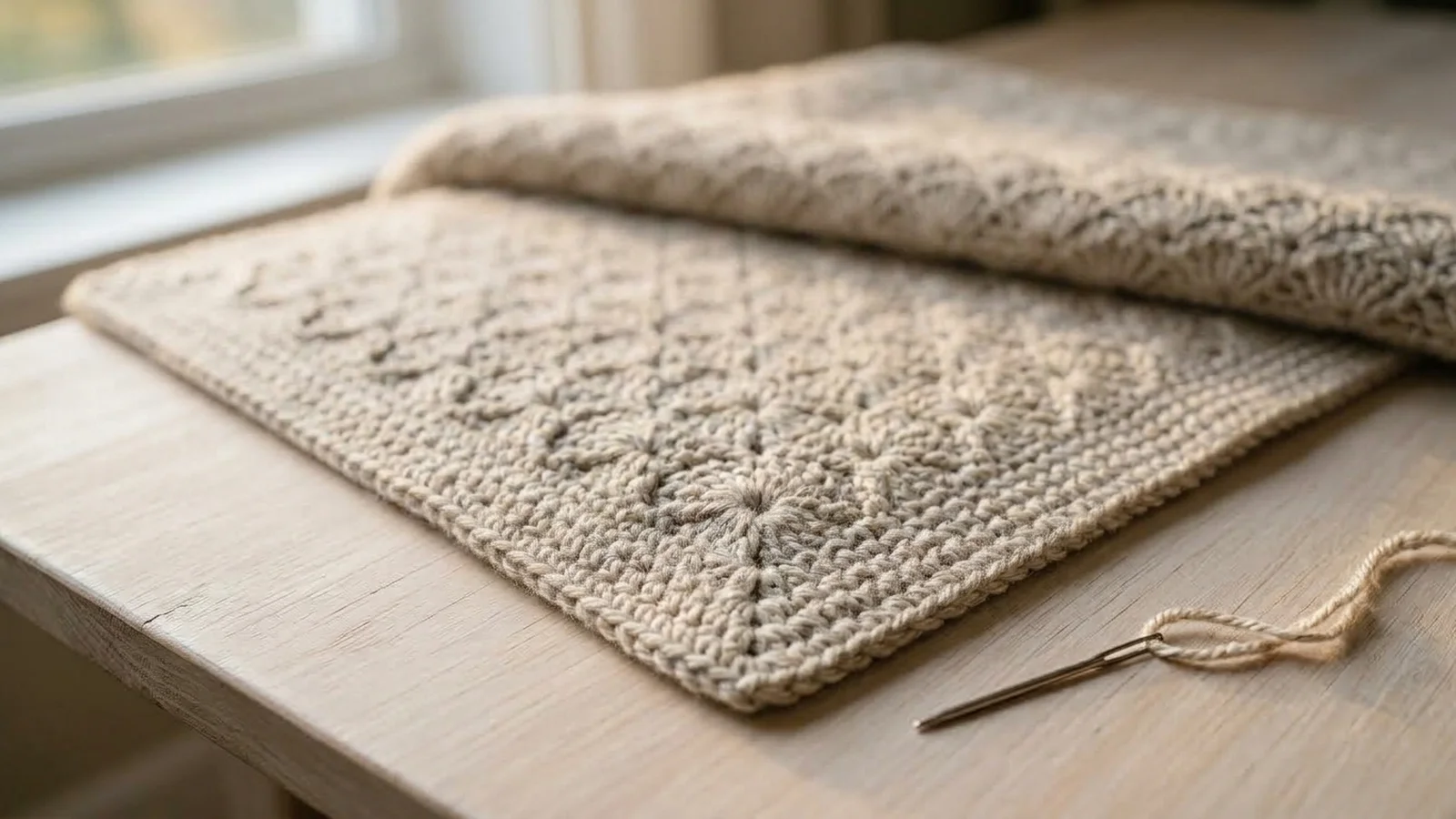
Weave in all ends along the wrong side, running each tail through the backs of several stitches rather than knotting it. Block the blanket before calling it finished — shell stitch changes shape more than most stitch patterns do once it’s wet or steamed, and blocking is what opens the shells into the fan shape they’re named for.
Customizing the Size
Because this stitch repeats over a multiple of 6 stitches, this shell stitch crochet blanket can be resized to almost any width without changing the pattern logic. Decide how many shells you want across, multiply that number by 6, then add 2 — that’s your foundation chain. Say you want 12 shells instead of 16: 12 × 6 + 2 = 74. Chain 74, and Row 1 reads the same way except you’ll repeat from * 11 more times instead of 15 (12 shells total), and Row 2 will repeat from * 10 more times (11 interior shells, plus the two edge half-shells).
Length doesn’t need a formula at all — just work Rows 1 and 2 until the piece is the height you want, using the gauge above (4 rows ≈ 2.5 in) to estimate how many rows that will take, and end on whichever row gives you the edge you prefer.
Blocking and Care
Shell stitch fabric benefits from blocking more than most textures, because the shells are held in a fanned shape mostly by tension until they’re set. Wet blocking or steam blocking both work for this stitch, though which one is appropriate depends on the fiber content of the yarn you chose. For the full step-by-step process, including how to handle acrylic differently from a wool blend, I’ve laid it out in how to block a crocheted blanket.
For everyday care after blocking, follow the yarn label rather than a general rule — acrylic and most acrylic blends can typically be machine washed on a gentle cycle and laid flat to dry, while animal-fiber blends usually need hand washing or a wool-specific cycle. I’d air on the side of the gentler method any time the label is ambiguous, since a shell stitch blanket has a lot of exposed loops that can snag more easily than a solid stitch fabric.
Why Shell Stitch for This Kind of Blanket
If you’re still deciding which stitch to use for a blanket, I’ve compared several options in best crochet stitch for a blanket. Shell stitch lands in a specific spot on that list: more textured and more yarn-hungry than a plain double crochet blanket, but considerably more open and drapey than a dense stitch like moss or waffle stitch. It’s a good match for a project that’s meant to be looked at as much as used, and a less practical choice if you want maximum warmth per yard of yarn.
Troubleshooting Shell Stitch Blankets
- Incorrect shell counts: If your row comes up short or long, count the dc in a few shells directly rather than re-counting the whole row. A shell with 4 or 6 dc instead of 5 is the most common source of a drifting stitch count, and it’s much faster to catch one bad shell than to recount 97 stitches.
- Missed spaces: Skipping 1 or 3 stitches instead of 2 shifts every shell after that point by one stitch, which usually shows up a few repeats later as the pattern visibly “leaning.” Placing a stitch marker in every fifth shell as you work makes this easy to spot within a single repeat instead of at the end of the row.
- Wavy edges: A ruffled edge usually means the half-shells at the ends of wrong-side rows are getting an extra dc, or the first sc of a right-side row is being skipped entirely. Check that each edge half-shell has exactly 3 dc (including the turning chain-3), and that Row 1 always opens with a single sc rather than a shell.
- Uneven row starts: If your rows start drifting narrower or wider than 97 stitches specifically at the beginning, it’s almost always the turning chain — either it isn’t being counted as the first dc on Row 2, or a stitch is being worked into the same base as the turning chain by mistake. Treat the ch-3 as stitch one and work your next dc into the same stitch, not the next one over.
Customization Ideas
A shell stitch blanket takes color changes well, since each shell reads as a distinct little unit. Changing yarn color at the start of a Row 1 keeps the color break clean along a straight edge, rather than mid-shell where it would show inside the fan. A single stripe every 8 to 10 rows, or a gradual ombré change every few skeins, both work without altering the stitch counts above.
If you’d rather substitute yarn, stay within the worsted weight category and re-swatch — moving to a DK or bulky weight will change both the gauge and the finished size math throughout this pattern, not just the softness of the fabric. If you want a lacier edge than the plain sc border above, an alternating shell-and-chain-1 edging is a reasonable swap, though it will read as more openly scalloped along the sides than the flat border described here.
Frequently Asked Questions
How many stitches are in a shell?
In this pattern, a full shell is 5 double crochets worked into the same stitch or space. At the two edges of every wrong-side row, you’ll work a half-shell instead — 3 double crochets, including the turning chain-3 — so the sides stay reasonably straight instead of scalloping outward the way a full shell would.
How does the shell repeat affect blanket width?
Every shell plus its neighboring single crochet uses 6 stitches, so the whole blanket is built on a multiple of 6. That’s why the foundation chain formula is (shells × 6) + 2 rather than an arbitrary number — the +2 accounts for the single crochet that starts the row. Adding one more shell to your count widens the blanket by roughly 3 in at this gauge; removing one narrows it by the same amount.
Can a shell stitch blanket be resized?
Yes. Width changes by choosing a different number of shells and recalculating the foundation chain with the formula above. Length changes even more simply, since you just work Rows 1 and 2 until the piece is as long as you want it, using the row gauge to estimate how many rows that will take.

Last updated . Found something out of date? Let us know.